
Maximizing agent talk time is one of the most effective levers outbound sales managers can pull to improve team performance. The more time agents spend in live conversations per shift, the more opportunities they create.
Yet research shows sales reps spend only 40% of their average workweek on actual selling activity. The rest goes to manual tasks, administrative work, and workflow friction.
Working with outbound teams across insurance, solar, real estate, and home services, we see the same pattern across industries. Small inefficiencies throughout the calling workflow add up, reducing contact volume, productivity, and revenue per agent.
In this article, we’ll cover the factors that affect agent talk time and the strategies outbound teams use to increase it.
TL;DR: 7 Ways to Maximize Sales Agent Talk Time
Agent talk time is the total time a sales agent spends in live conversation with prospects during an outbound campaign or shift. It’s a core productivity metric for outbound teams because it measures actual selling activity rather than just call volume.
Here are seven best practices for maximizing agent talk time:
- Use a predictive dialer to significantly reduce idle time between live conversations.
- Automate after-call work with custom dispositions so agents can move to the next call faster.
- Prioritize high-intent leads at the top of every dialing list.
- Use dynamic scripts to open every call with lead-specific context.
- Monitor caller ID reputation across all major U.S. carriers to protect contact rates.
- Consolidate your tools into a single platform to eliminate workflow friction.
- Track talk time and contact rate data regularly to catch problems before they compound.
What Is Agent Talk Time?
Agent talk time is the total time a sales agent spends in live conversation with prospects or customers during an outbound campaign or shift. It measures the portion of each sales call during which an agent is actively speaking with a prospect, excluding hold time, ringing, and after-call work.
It differs from average handle time, which includes hold time and after-call work alongside the live conversation. In other words, talk time represents the portion of handle time spent in actual conversation with a prospect.
To calculate average talk time, divide total talk time by the number of calls handled during the same period.
For outbound sales and lead generation teams, the goal is for agents to spend the majority of their working hours in live conversation rather than in the downtime between connections.
Why Maximizing Talk Time Per Agent Matters
Higher talk time is not an end in itself. The benefits show up in three key areas:
1. More Time in Productive Conversations Increases Revenue Potential
Gong Labs analyzed thousands of cold calls and found that successful cold calls tend to last significantly longer than unsuccessful ones, averaging 5 minutes 50 seconds versus 2 minutes 45 seconds. While conversation length alone does not determine outcomes, the finding highlights the value of creating more opportunities for meaningful prospect engagement.
Teams that maximize live conversation time get more value from every working hour because agents spend a greater share of their shift engaged in actual selling activity.
2. Higher Talk Time Improves Efficiency Without Increasing Workload
The goal is to make the hours agents already work more productive, not to add more hours or
more dials to their day.
When agents spend less time on manual tasks and more time speaking with prospects, performance becomes easier to sustain. Teams that chase volume without addressing workflow friction eventually hit a ceiling, as agents are forced to work harder just to maintain the same results.
3. Faster Lead Response Improves Contact Rates
Maximizing agent talk time reduces the delays that often occur between a lead entering the system and receiving a call. Reaching prospects sooner increases the likelihood of making contact while interest is still fresh, which can improve both the customer experience and overall campaign performance.
Tools and Best Practices to Maximize Talk Time Per Agent
Low talk time isn’t always a coaching issue. In many cases, operational inefficiencies and outdated tools are the real cause. Here are seven ways to remove those barriers:
1. Use a Predictive Dialer to Reduce Idle Time
A predictive dialer is a calling tool that places multiple calls simultaneously and connects agents only when a live person answers. Unanswered calls, voicemails, and disconnected numbers are filtered out before the agent ever hears a ring.
Manual dialing creates downtime between conversations as agents wait through unanswered calls, voicemails, and disconnected numbers. A predictive dialer with built-in answering machine detection (AMD) reduces that downtime by identifying and skipping voicemails in real time, so agents can move from one live conversation to the next.
Readymode’s predictive dialer supports up to 20+ concurrent calls per agent with built-in answering machine detection. All four dialing modes (preview, power, progressive, and predictive) are available across every plan, so teams can match their dialing approach to the needs of each campaign.
When Premier Home Solutions switched from manual dialing to Readymode’s predictive dialer, they achieved a 4x increase in productivity and booked more appointments daily as a result.
2. Automate After-Call Work With Custom Dispositions
After-call work is the time agents spend logging outcomes, scheduling follow-ups, and updating records after each conversation ends. While each task takes only a few moments, those minutes add up quickly across a full shift.
Custom dispositions, which are predefined call outcome labels, help eliminate that friction. Instead of manually navigating CRM fields or switching between tools after every call, agents select the disposition that best matches the outcome of the conversation. Depending on how the platform is configured, that selection can also trigger follow-up actions such as scheduling a callback, routing a warm transfer, or closing a lead.
This allows agents to move to the next conversation faster without skipping any part of the post-call workflow.
Readymode includes custom one-click dispositions across all plans. For teams that need more advanced workflow automation, Readymode iQ includes custom call cadences that help control how and when leads are contacted, cutting the guesswork.
3. Prioritize the Right Leads at the Right Time
Lead prioritization means structuring dialing lists so agents reach the highest-intent, best-fit contacts first rather than working through flat lists in sequential order. Agents who connect with high-intent contacts are more likely to have meaningful discussions rather than cycling through quick rejections, unanswered calls, and disconnects.
A flat, unsegmented list treats every contact equally regardless of how likely they are to answer or engage. As a result, agents burn through talk time on low-priority contacts while higher-intent leads sit further down the queue.
Readymode includes built-in lead management tools that let teams create custom dialing lists and automate lead assignment.
4. Use Dynamic Scripts to Personalize Every Conversation
Dynamic call scripts automatically pull lead-specific details such as name, location, campaign, and lead source into the script before the agent makes the call. Every opener is personalized without requiring any manual prep from the agent.
Relevant context helps agents start conversations more naturally and reduces friction during the opening moments of a call. Dynamic scripts also give agents a reliable framework, so conversation quality is less dependent on individual improvisation.
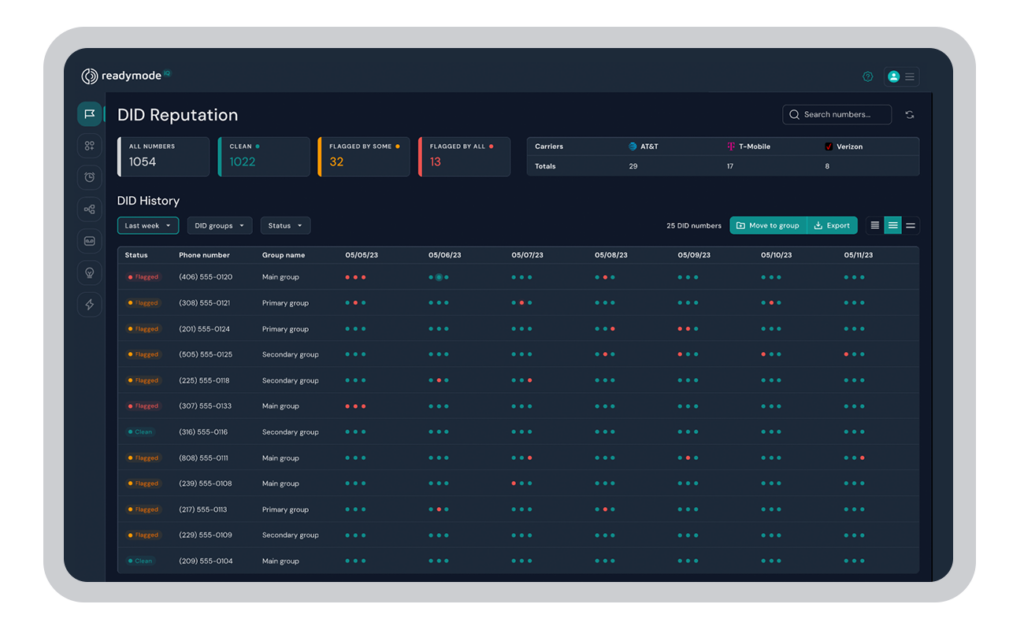
5. Improve Contact Rates With Smarter Caller ID Management
Caller ID reputation management is the practice of monitoring how your outbound numbers appear to recipients and taking action before flagged numbers begin hurting contact rates.
Pew Research Center found that 8 in 10 Americans do not answer calls from unknown numbers. When a number is flagged as spam or suspicious, contact rates can fall even further. Most teams see the drop in their metrics before they identify the cause because they have no visibility into how their numbers appear across different carrier networks.
With Readymode iQ, you can see which numbers are flagged by major U.S. carriers and identify issues before they affect performance. The built-in Autopilot feature selects the healthiest number based on lead-specific carrier data, while Assisted Remediation helps maintain a positive caller ID reputation and reduce negative call labels.
6. Reduce Tool-Switching With an All-in-One Platform
An all-in-one outbound platform combines the dialer, CRM, lead management, compliance tools,
and reporting in a single interface.
Most outbound teams run on a fragmented stack where agents switch between a dialer, a separate CRM, a spreadsheet for lead lists, and additional tools for compliance and reporting. Beyond the time cost, context-switching breaks the mental momentum agents need to stay consistent across a high-volume calling day, and that inconsistency can show up in conversation quality.
Readymode is an all-in-one platform with built-in CRM, lead management, dynamic scripts, compliance tools, and reporting. Agents work within one interface from the start of the shift to the end, with no need to switch tools between calls.
7. Monitor Performance Data to Catch Problems Early
Performance reporting in an outbound dialer gives managers real-time and historical data on talk time, contact rates, agent activity, and campaign outcomes. For talk time specifically, reporting can help you identify whether a drop is caused by list quality, flagged numbers, excessive after-call work, or dialing configuration. Those are four completely different problems that require four completely different fixes.
Talk time trends can also help managers identify whether a problem affects the entire team or only specific agents. A team-wide decline may point to a platform or dialing issue, while an individual decline may indicate a coaching opportunity.
Readymode includes advanced reporting and analytics with campaign-level performance data, agent activity tracking, and caller ID reputation monitoring so managers have the visibility to act before small drops become bigger ones.
Talk Time Optimization Checklist
Answer the following questions to identify factors that may be reducing your team’s talk time:
- Are agents spending most of their time in live conversations rather than on manual tasks such as dialing, data entry, and post-call administration?
- Are agents using a predictive dialer rather than manually dialing each number?
- Are your outbound numbers monitored for spam flags and caller ID reputation issues?
- Are lead lists clean, segmented, and prioritized by intent before agents begin dialing?
- Do agents complete after-call work using custom dispositions rather than navigating multiple tools?
- Are dynamic scripts pulling lead-specific details into calls automatically?
- Is your team operating from a single platform rather than switching between tools throughout the day?
- Are managers reviewing talk time, contact rates, and campaign performance regularly enough to identify issues early?
Maximizing Agent Talk Time Isn’t Complicated
Low agent talk time rarely comes down to one thing, and fixing one cause while leaving the others untouched produces only partial results.
The teams that improve talk time consistently look at the entire workflow. Dialing modes, after-call processes, lead prioritization, caller ID reputation, and platform consolidation all contribute to the outcome.
The tools and practices we’ve covered in this article address each of those areas. The next step is putting them into practice for your team. Book a demo with Readymode to see how our platform supports outbound teams across every stage of the calling workflow.

Jawad Khan
Jawad is a seasoned content marketer and freelance technology writer featured in some of the world's leading digital marketing, e-commerce, and software related publications. As an expert contributor, Jawad has written for startups and enterprises, including Fortune 500 companies, across various tech verticals.