
Did you know that 90% of sales professionals already feel burned out at work?
The outbound sales reps who burn out fastest are rarely the weakest ones on the team. They’re often the people who showed up motivated, worked the phones hard, and gradually ran into obstacles that kept getting in the way of results.
At Readymode, we see this across high-performing outbound teams that switch to our platform looking for ways to reduce burnout and turnover.
High call volume, flat results, repeated prospect rejections, and little visibility into why performance isn’t improving can wear people down over time.
When that continues without the right tools or support, even strong reps can disengage. And when they leave, they take their experience, their pipeline knowledge, and months of training investment with them. Much of this is largely preventable.
In this article, we’ll explain why sales reps burnout, what it costs, and what managers can do to build outbound teams that retain strong performers.
TL;DR: What Is Sales Rep Burnout and How to Prevent It
Burnout in outbound sales is what happens when sustained pressure, repeated rejection, and diminishing results wear a rep down far enough that they stop performing at the level they’re capable of.
The three biggest drivers we see across outbound teams:
- Reps are reaching fewer prospects because of call screening and flagged numbers, and they have no visibility into why.
- Too much of every shift goes to non-selling tasks like manual dialing and logging calls instead of actual conversations.
- Rejection compounds burnout when there is no feedback loop helping reps understand what to do differently.
What we have seen work to prevent burnout among sales reps:
- Coach reps in real time using live call monitoring.
- Track lead list performance separately from rep performance.
- Use an integrated dialing platform so reps can do more faster.
- Protect contact rates with caller ID reputation monitoring to minimize dialing from flagged numbers.
- Use Answering Machine Detection to keep agents in live conversations instead of navigating voicemails manually.
- Give reps lead context inside the dialer so they can personalize conversations.
- Show reps a clear career path forward inside the organization.
What Burnout Looks Like in Outbound Sales
Burnout among outbound sales agents happens when sustained pressure, repeated rejection, and diminishing results wear a rep down to the point where they stop performing at the level they’re capable of, even when they’re still showing up. Left unaddressed, it tends to follow a predictable path.
Their performance drops, motivation to recover it drops further, and they either disengage completely or quit. In either case, the team loses someone the organization has already spent time and resources developing.
Burnout shows up gradually. The rep who used to make 150 calls a shift starts wrapping up at 100. The one who had energy in their voice now sounds like they’re reading from a script. Conversations that used to flow start getting cut short.
By the time a manager notices it, it has typically been building for a while.
The Top Challenges Outbound Reps Face in 2026
Outbound has always been a demanding job. But several things have shifted recently that make it harder than it was even two years ago. These are the challenges we see driving burnout and turnover most consistently across the teams we work with.
1. Increased Call Screening and Flagged Numbers
With Apple’s iOS 26 call screening now giving prospects an easy way to decline calls before they connect and carriers increasingly labeling outbound numbers as spam or “scam likely,” reps are reaching fewer people on the same number of dials.
What makes this particularly damaging to morale is that the rep has no visibility into it. They assume the list is bad or that their pitch isn’t landing when the real problem is that their number was flagged two weeks ago and nobody caught it.
2. Higher Buyer Expectations
Prospects today expect the rep on the other end of the call to know who they are, why the outreach is relevant, and why now is the right time to have the conversation.
Reps who aren’t equipped with quality lead data, dynamic scripts, or clear campaign context spend more of every shift struggling to move conversations past the opening moments.
Repeated early rejections, especially when a rep doesn’t understand why they’re happening, accelerate burnout faster than any other single factor we see.
3. Too Much Time Spent on Non-Selling Tasks
According to Salesforce’s State of Sales research, sales reps spend 70% of their time on non-selling tasks.
A rep who spends three hours of a five-hour shift manually dialing, logging call outcomes in a separate CRM, and switching between disconnected tools has had few meaningful conversations by the time the shift ends.
Over time, those inefficiencies can compound into the kind of exhaustion that is difficult to fix through coaching or encouragement alone.
4. Rejection Without a Feedback Loop
Rejection is part of outbound. Every rep knows that going in. What breaks people is not the rejection itself but the inability to learn anything from it.
When a rep doesn’t know whether a hung-up call came from a bad lead, a flagged number, a weak opening, or simply bad timing, every rejection can feel personal and difficult to improve on.
How Supporting Outbound Reps Impacts Your Bottom Line
Sales rep burnout usually results in high turnover and measurable losses across the business, affecting revenue, productivity, and customer experience. Here’s why solving it should be a top priority:
1. Turnover Is Expensive
According to Gallup, replacing an employee costs between 50% and 200% of their annual salary.
In outbound sales, where a new rep typically takes three months or more to ramp to full productivity, every departure can create a prolonged period of reduced output before a replacement is fully contributing.
This cost is often easy to overlook because it’s spread across recruiting time, onboarding resources, manager bandwidth, and lost pipeline rather than appearing as a single line item.
2. Burnout Lowers Productivity Before Reps Quit
A burned-out rep rarely stops performing overnight. They slow down gradually, making fewer calls, having shorter conversations, and converting at a lower rate.
By the time the decline becomes visible in reporting, it has often been building for some time. A team operating at full headcount but with lower engagement can still underperform compared with a smaller, highly engaged team, and that gap can affect pipeline growth and overall results.
3. Poor Morale Affects the Customer Experience
Prospects pick up on tone and energy in a call, often within the first few seconds. A rep who is disengaged or exhausted sounds like it, and that affects how the conversation develops even before the pitch begins.
Beyond individual calls, high turnover can disrupt continuity for leads mid-cycle.
A prospect who built rapport with one rep and then gets handed to someone new may feel less connected to the conversation, creating additional friction in the sales process.
7 Proven Ways to Prevent Burnout and Improve Retention in Outbound Sales
Outbound teams that keep sales rep burnout under control have a few things in common. They run tighter operations, give their reps better tools, and treat retention as a performance metric instead of an HR concern.
Here is what we have seen work consistently:
1. Invest in Ongoing Coaching and Feedback
Reps who receive regular coaching are better equipped to learn from difficult calls and challenging shifts. Without that feedback, bad shifts can feel discouraging instead of becoming a chance to learn.
Readymode includes live floor monitoring with the ability to listen, whisper, or interject on live calls. It allows managers to coach in real time without pulling a rep off the floor or waiting until the end of the week to surface what went wrong.
That immediacy can make coaching more effective. A rep who receives constructive coaching during a live call can put it into practice right away.
2. Review Lead Quality, Not Just Rep Performance
When contact rates drop and rejection climbs, the first instinct is usually to focus more heavily on coaching the rep. In our experience, the contact list is often where the problem starts.
Poor-quality lead data means reps spend more of their shift reaching disconnected numbers, contacting unqualified leads, and losing conversations before they have a chance to develop.
That experience, repeated across hundreds of calls a week, grinds people down regardless of how resilient they are.
Readymode’s reporting and insights feature lets managers track performance at the campaign and list level so lead quality problems get identified and corrected before they become a morale problem.
Our lead management tools also let you prioritize higher-quality contacts and route them to the right agents, reducing the time reps spend on mismatched campaigns and low-value outreach.
3. Reduce Time Spent on Repetitive Tasks
Reps who spend most of their shift on tasks unrelated to prospect conversations have less time and energy for the work that moves deals forward.
Manual dialing, logging calls in a separate system, and switching between disconnected tools mid-shift are the kinds of friction that can make an already demanding job feel unsustainable.
Readymode combines dialing, CRM, lead management, and reporting in one platform. Agents stay in one place throughout their shift, call outcomes log automatically, scripts appear alongside lead information, and the next contact queues without manual input.
This creates more opportunities for conversations and reduces the administrative workload that can gradually wear reps down over time.
One of our clients, Premier Home Solutions, experienced this firsthand.
After moving their appointment-setting operation to Readymode, their team of 25+ setters was fully onboarded and productive on day one. They went from manually tracking everything in spreadsheets to a 4x increase in productivity, with the time previously spent on admin going back into actual selling.
4. Give Reps the Context They Need Before the Conversation Starts
One often overlooked contributor to burnout is going into call after call with little context about who is on the other end and no meaningful starting point for the conversation.
Readymode’s built-in CRM surfaces lead history, contact details, previous call outcomes, and relevant context directly inside the dialer before and during the call.
Agents do not need to search for information or pull it from separate systems during a conversation. The context is already available when the call connects.
This gives both inexperienced and seasoned reps a stronger foundation for the conversation. Instead of relying entirely on a script, they can use what they already know about the prospect to make the conversation more relevant and focus on what matters most to that person.
5. Protect Contact Rates With Caller ID Reputation Management
Few things wear down an outbound rep faster than putting in consistent effort and reaching almost nobody. When that happens because numbers have been flagged and reps have no visibility into it, the experience can become especially frustrating because the issue sits outside their control.
Readymode iQ includes caller ID reputation monitoring and Assisted Remediation so teams can identify flagged numbers and address issues before they affect campaign performance.
Our Autopilot feature uses carrier-level data to select the number most likely to connect with each lead. It can also route partially flagged numbers toward carriers where they remain trusted, so teams get more from their existing number pool.
More successful connections create more opportunities for meaningful conversations, giving reps more consistent opportunities to build progress.
6. Use Answering Machine Detection to Keep Reps in Live Conversations
Voicemails are a normal part of outbound campaigns. But when agents spend a significant portion of their shift manually working through them, less time goes toward actual conversations with prospects. Repeating that process throughout the day adds unnecessary strain.
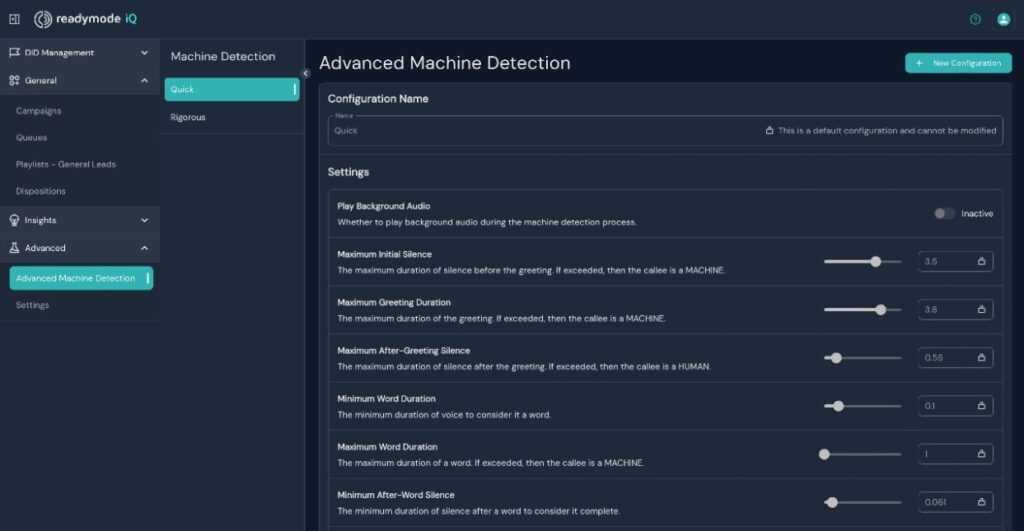
Answering Machine Detection (AMD) in Readymode iQ filters voicemail automatically across power, progressive, and predictive dialing modes, connecting agents to live answers instead. Reps spend more of their shift in active conversations, where they can influence outcomes and make progress toward their goals.
Even small reductions in repetitive work can make the role feel more manageable and rewarding.
7. Give Reps a Clear Path Forward
Outbound roles are often viewed as entry points rather than long-term career paths. When reps cannot see where the role can lead, retention becomes more difficult as they gain experience and additional opportunities become available.
The teams that successfully retain their strong performers often create visible paths from rep to senior rep, team lead, or specialist roles. That does not have to mean a promotion every six months. It means reps can see that the skills they are building have somewhere to go within the organization.
That visibility can shape how people approach the difficult parts of the job and provide a stronger reason to stay engaged.
Prevent Rep Burnout With Readymode
Burnout in outbound sales is not inevitable, but it rarely improves without intentional changes.
Teams that retain strong reps often reduce unnecessary obstacles, provide the right tools, and create an environment where people can perform consistently. They also give reps visibility into their work, opportunities to grow, and a clearer sense of where the role can lead.
Readymode brings together tools for dialing, lead management, coaching, and reporting to support many of these areas.
If you’d like to see how those workflows operate in practice, book a free demo.

Jawad Khan
Jawad is a seasoned content marketer and freelance technology writer featured in some of the world's leading digital marketing, e-commerce, and software related publications. As an expert contributor, Jawad has written for startups and enterprises, including Fortune 500 companies, across various tech verticals.