
Few things kill outbound momentum faster than a call that drops mid-pitch. Or one that ends before it even begins.
Dropped calls and abandoned calls are two of the most consistent drains on outbound performance, and they affect more than just your contact rate. Left unaddressed, they damage your caller ID reputation, create compliance exposure, and wear down the agents dealing with them shift after shift.
But both are preventable, and the fix usually starts with knowing what’s causing them.
Dropped calls and abandoned calls have different causes and different solutions, and treating them as one is exactly why many sales teams stay stuck longer than they need to.
In this article, we’ll explain what each one is, what causes them, and what your team can do to prevent both.
TL;DR: How Sales Teams and Call Centers Can Prevent Abandoned and Dropped Calls
In sales campaigns, an abandoned call happens when a contact answers but no agent is available to take the call. A dropped call happens when a live conversation disconnects due to a technical failure. They are different problems, but they often share the same root causes.
Here is what you need to know:
- The FTC’s Telemarketing Sales Rule (TSR) provides a safe harbor allowing abandoned calls at or below 3% of live answered calls per campaign (or per 30-day period for longer campaigns). Exceeding that threshold can create compliance exposure and increase enforcement risk.
- A poorly configured dialer, understaffing, and bad lead list data are the most common causes of abandoned calls.
- Network instability, poor VoIP infrastructure, and wireless headsets on unstable connections are the most common causes of dropped calls.
- Cleaning your lead list, configuring your dial ratio to match your team size, and choosing the right dialing mode for each campaign prevents most abandoned calls before they happen.
- Using wired equipment and a stable internet connection eliminates the most common agent-side dropped call risk.
- Answering Machine Detection, available in Readymode iQ, reduces the pressure to overdial by filtering voicemails before calls reach agents.
- Real-time reporting lets managers catch rising abandonment rates while there is still time to act, not after the damage is done.
What Are Dropped and Abandoned Calls in Outbound Sales?
In the context of sales outreach campaigns, dropped calls and abandoned calls describe two different failures happening at two different points in a call.
Abandoned Calls
An abandoned call happens when a contact picks up but disconnects before reaching an agent. This can occur when a poorly configured predictive or progressive dialer places calls faster than sales agents are available to take them.
The prospect answers the call, hears silence, and hangs up before a conversation ever starts.
Abandoned calls are also called silent calls or dropped outbound calls.
Dropped Calls
Dropped calls (also referred to as disconnected calls or failed calls) happen when a live conversation disconnects before it reaches a natural end because of a technical failure somewhere in the connection.
This can come from VoIP instability on the dialing platform, a weak or inconsistent internet connection on the agent’s end, or a software issue that interrupts the call midstream.
The key distinction from an abandoned call is the timing of the disconnection. A dropped call happens after an agent and a contact are already in a conversation, which makes it a different kind of failure with a different cause and a different fix.
The Most Common Causes of Dropped and Abandoned Calls
In our experience working with outbound teams and call centers, here are the most common reasons behind dropped and abandoned calls during sales campaigns.
- Poorly Configured Dialer: When a predictive dialer’s ratio is set too aggressively for the number of agents available, it places more calls than agents can handle. Contacts pick up and get silence instead of a conversation. The dialer is doing exactly what it was configured to do. The configuration is just wrong for the team size running it.
- Agent Wrap Time and Pacing Mismatch: When agents take unusually long between calls to log notes, update records, or close a contact, the dialing speed might not line up. That gap between when an agent finishes a call and when they’re actually ready for the next one creates a window where new connections might come in with nobody available to take them.
- Understaffing: If your team is too small for the dialing speed you’re running, abandoned calls are inevitable regardless of how well the dialer is configured. You should slow the dialer down to match your agent headcount or hire to match the pace you want to run.
- Network Instability and Poor VoIP Quality: A weak internet connection on the agent’s end, a VoIP provider running on substandard infrastructure, outdated hardware, or wireless headsets on unstable networks can all lead to calls dropping unexpectedly.
- Low Lead List Quality: According to research, poor data quality costs businesses an average of $12.9 million annually. When a significant portion of your list is made up of disconnected numbers, wrong contacts, or people who never opted in, your unanswered call rate climbs. To keep agents busy, managers push the dial ratio higher, which increases the risk of abandoned calls. The dialer looks like the problem, but the list is where it started.
| Cause | Type of Call Affected | What Happens |
| Poorly configured dialer | Abandoned | Dial ratio exceeds agent availability. Contacts answer to silence. |
| Agent wrap time and pacing mismatch | Abandoned | Agents not ready between calls. New connections arrive with no one to take them. |
| Understaffing | Abandoned | Team too small for the dialing speed being run. Math doesn’t work regardless of configuration. |
| Network instability and poor VoIP quality | Dropped | Mid-conversation disconnection due to weak connection, bad infrastructure, or outdated hardware. |
| Low lead list quality | Abandoned | Bad data inflates unanswered call rate, pushing managers to overdial, which raises abandonment risk. |
Why You Must Resolve Dropped and Abandoned Calls
As an outbound customer engagement platform working with sales teams and call centers across industries, we at Readymode know from experience that dropped and abandoned calls affect your business in ways that go beyond performance metrics.
Here’s why resolving these problems should be a priority for every outbound team.
1. Reduce Compliance Risk
The FTC’s Telemarketing Sales Rule provides a safe harbor for abandoned call rates at or below 3% of live answered calls, measured over the duration of a single campaign if it lasts fewer than 30 days, or separately over each successive 30-day period.
An abandoned call under the TSR is specifically defined as a call that connects to a live person but does not reach an agent within two seconds of the end of the contact’s greeting. Exceeding that threshold removes the safe harbor protection and increases your exposure to FTC enforcement action, which can include significant fines.
Readymode gives teams real-time visibility into their abandonment rate, and the dialer automatically adjusts dialing speed to help stay within a configured abandonment threshold (below 3%).
Your team remains ultimately responsible for staying within the limits set by the TSR, but having that visibility and automation during live campaigns makes active compliance management much easier.
2. Protect Brand Reputation
In outbound sales, first impressions shape how prospects perceive your business before a real conversation even starts. When a prospect picks up your call and hears silence, or when a live conversation drops mid-sentence without a quick callback, they form a negative impression of your brand.
One abandoned call is an inconvenience for the prospect. But a pattern of them from the same number signals either a disorganized operation or an automated dialing system that nobody is actually managing.
Either way, this makes it much harder for your agents to build the necessary trust to start a sales conversation.
3. Prevent Spam Labeling and Call Blocking
Frequent abandoned calls can create a poor experience for contacts, increasing the chance that some will report your number as spam. Spam reports trigger carrier-level flagging, and once a number is flagged, your contact rate can drop across every campaign running on it, not just the one that generated the complaint.
4. Maximize ROI
Every contact on your list represents acquisition spend. Your company paid to generate that lead and get it into your dialer.
An abandoned call wastes that investment before it produces anything. A dropped call is even costlier because a real conversation was already underway and still went nowhere.
When these calls happen at volume across a campaign, the cumulative cost in wasted leads and lost agent time adds up fast. Your dial volume may look healthy on paper, but your actual return on that spend goes down.
5. Improve Team Morale
When agents constantly deal with calls that drop mid-conversation or numbers getting flagged because of high abandonment rates, motivation starts to decline.
They’re putting in the effort, but the results don’t reflect it, which can be frustrating for teams trying to hit goals.
In our experience, high dropped and abandoned call rates consistently contribute to agent burnout and turnover when the underlying causes go unresolved.
Best Practices for Preventing Dropped and Abandoned Sales Calls
As we mentioned earlier, dropped and abandoned calls are separate problems, but both can be addressed through the right platform, processes, and ongoing monitoring.
These are the practices we recommend to outbound teams and call centers who come to us dealing with both problems.
1. Use a Reliable Outbound Calling Platform
The foundation of any dropped call prevention strategy is the platform your team dials on. If your predictive dialing software runs on substandard carrier infrastructure, call quality problems can affect every campaign before agents even pick up the phone.
A reliable platform runs on Tier 1 carriers, which means cleaner connections, more consistent audio quality, and fewer calls dropping unexpectedly for reasons outside your agents’ control.
Readymode runs on Tier 1 carrier infrastructure across all plans, providing a dependable calling environment for teams running outbound campaigns.
2. Configure Your Dialer Settings for Your Team Size
The most direct fix for the most common cause of abandoned calls is getting your dialer configuration right. Your dial ratio needs to reflect your actual agent headcount and average wrap time, not the maximum the platform allows.
When the ratio is set too aggressively for the number of available agents, contacts can answer before an agent is ready, causing abandonment rates to rise.
Readymode lets managers set abandonment thresholds and adjust dialing pace based on the number of agents actively available at any given moment. When a campaign starts running ahead of agent capacity, our predictive dialer automatically dials slower to keep the abandonment rate within the configured threshold.
This is what keeps abandonment rates manageable in high-volume predictive campaigns without requiring a manager to manually intervene every time the ratio shifts.
3. Experiment with Dialing Modes and Speed
Not every campaign needs predictive dialing, and not every team has the headcount to run it safely at high speed.
When predictive dialing is not set up or used properly, it can carry more abandonment risk than single line modes like preview or power because it dials ahead of confirmed agent availability.
For smaller teams, compliance-sensitive campaigns, or lower-quality lists, a more conservative mode reduces abandonment risk without giving up the efficiency gains that come from automated dialing.
As we cover in our guide on predictive dialer myths, abandoned calls are a risk for any dialing mode, but the degree of risk varies significantly depending on how you configure and run each one.
Readymode includes preview, power, progressive, and predictive dialing modes across all plans, with the ability to manage dialing speed based on a preset abandonment threshold and the number of agents available.
That gives managers the flexibility to match the dialing approach to the campaign rather than forcing every campaign through the same strategy.
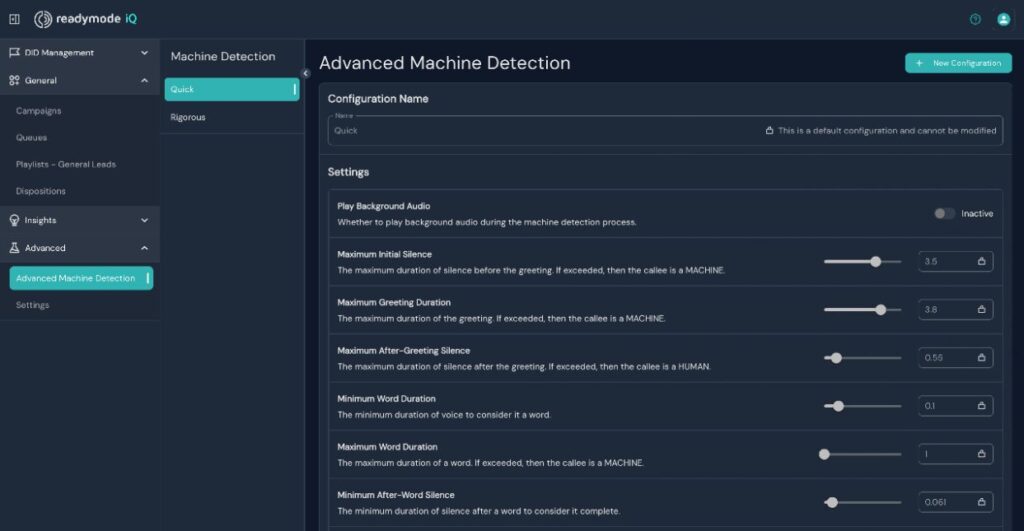
4. Use Answering Machine Detection
When agents spend part of their shift fielding voicemails manually, managers often compensate by pushing the dial ratio higher to keep talk time up. That response to a voicemail problem creates an abandonment problem.
Answering Machine Detection (AMD) filters voicemail before calls reach agents, which means agents can stay focused on live conversations. That reduces the pressure to overdial just to keep agents utilized.
Advanced AMD is available in Readymode iQ across power, progressive, and predictive dialing modes. It does not apply to preview mode, where the agent initiates each call manually.
Teams running Readymode iQ with AMD active get more live conversations per shift without needing to push dial ratios beyond what their headcount can safely support.
5. Use a Wired Headset and a Stable Internet Connection
Most dropped calls that are not platform-level problems are agent-side. Wireless headsets on shared networks, home office connections without enough bandwidth, and outdated hardware are the most common culprits.
The contact on the other end does not know it was a technical failure. They just know the call ended, which can affect how they respond the next time you reach out.
A wired headset and a dedicated, tested internet connection remove the most common agent-side dropped call risk before it affects a live conversation. It’s also worth running a network test across your team periodically to rule out connection issues that agents may not have flagged themselves.
6. Monitor Performance Continuously
By the time weekly reporting surfaces a rising abandonment rate, the damage may already be underway. Your caller ID reputation could be taking hits, and depending on how long the rate has been climbing, you may already be approaching the FTC’s 3% TSR threshold without anyone on the team being aware of it.
Real-time visibility helps teams identify problems early instead of diagnosing them after the damage is done.
Readymode’s reporting suite gives managers visibility into abandonment rate, contact rate, and agent-level performance during active campaigns. When a metric starts moving in the wrong direction, you see it while there’s still time to adjust, not weeks later when the final campaign numbers come in.
Fix the Fundamentals to Prevent Abandoned and Disconnected Calls
Dropped and abandoned calls are not the same problem, but their solution often lives in the same place: cleaning up your lead list, using reliable equipment, running an automated dialer built for outbound, and configuring it to match your actual team size and campaign needs.
Getting those pieces right can reduce many of the factors that contribute to both issues before they affect performance. Ignoring them often creates downstream problems that are harder to diagnose later.
Readymode helps prevent both abandoned and disconnected call problems with an integrated approach. To see it in action, book a free demo, and we’ll walk you through it.

Jawad Khan
Jawad is a seasoned content marketer and freelance technology writer featured in some of the world's leading digital marketing, e-commerce, and software related publications. As an expert contributor, Jawad has written for startups and enterprises, including Fortune 500 companies, across various tech verticals.