
Did you know that 87% of consumers believe unidentified numbers may be fraudulent?
Consumers are increasingly protective of their privacy and far less likely to answer calls they do not recognize. This shift is reflected in changes like Apple’s iOS 26 call screening feature, which adds another layer of filtering for unknown callers.
For outbound sales and lead generation teams, this makes caller ID reputation critical. If your numbers are flagged or appear untrusted, your calls may never reach a real person.
The challenge is that many caller ID management tools promise strong protection but operate in ways that introduce hidden limitations.
In this article, we’ll explain how caller ID reputation management works, where many tools fall short, and how Readymode iQ helps teams protect their caller ID reputation and improve connect rates.
TL;DR: What Is Caller ID Reputation Management and How to Do It Effectively
Caller ID reputation management is the process of monitoring, protecting, and improving how your phone numbers appear to prospects when you make outbound calls.
It matters because numbers that show up as “Spam Likely” or go unidentified dramatically reduce answer rates, making it harder for sales and lead generation teams to connect, qualify leads, and drive revenue.
The Problem With Most Caller ID Reputation Tools
- They react after numbers are already flagged instead of preventing damage.
- They rely on delayed or incomplete reputation data.
- They replace numbers rather than fixing dialing behavior.
- They waste partially flagged numbers instead of using them strategically.
- They require manual effort and operate outside daily workflows.
What Caller ID Platforms Should Do Instead
- Use proactive controls that protect numbers before issues occur.
- Monitor reputation at the carrier level with frequent updates.
- Manage call volume, pacing, and timing per number.
- Deploy numbers strategically based on carrier trust.
- Use caller ID tools built directly into outbound operations.
Readymode iQ brings all of this together in one outbound platform. It helps teams prevent flagged calls, extend the life of their phone numbers, and maintain higher connect rates through proactive, carrier-aware caller ID management.
Book a demo and explore Readymode iQ firsthand.
What Is Caller ID Reputation Management?
Caller ID reputation management (also referred to as phone number reputation management or DID reputation management) is the process of monitoring, maintaining, and improving how your phone numbers are viewed by carriers and call recipients when you place outbound calls.
Its goal is to ensure your numbers appear trustworthy and are less likely to be labeled as spam, fraud, or unknown, which helps increase the likelihood that your calls are delivered and answered.
This is necessary because phone numbers do not start with a fixed reputation. Their reputation is shaped over time based on how they are used.
High call volumes from a single number, repeated unanswered calls, short call durations, rapid dialing patterns, or recipient actions such as declines and spam reports can all signal risk to carriers.
As these signals accumulate, carriers may apply warning labels, filter calls, or reduce delivery rates.
For outbound sales and lead generation teams, this directly impacts performance. Even well-targeted outreach can fail if numbers are flagged or deprioritized.
Caller ID reputation management helps teams understand these risks, adjust calling behavior, and protect their numbers so outbound calling efforts lead to more live conversations instead of missed or blocked calls.
The Benefits of Caller ID Reputation Management for Outbound Teams
Caller ID reputation management plays a critical role in the performance and sustainability of outbound calling programs. When managed correctly, it supports higher connect rates and more efficient operations.
- Improves answer rates: Calls from trusted phone numbers are more likely to be answered, giving agents more opportunities to speak with live prospects.
- Reduces wasted dialing effort: Fewer calls are sent to voicemail or blocked, which means less time spent dialing numbers that never connect.
- Protects long-term number performance: Proactive reputation management helps prevent numbers from being overused or flagged, extending their usable lifespan.
- Supports consistent campaign results: Stable caller ID performance leads to more predictable outreach outcomes across campaigns and teams.
- Creates a better prospect experience: When calls appear legitimate and recognizable, prospects are less likely to feel interrupted or suspicious, leading to more productive conversations.
How Caller ID Reputation Management Tools Typically Work
Caller ID reputation management tools are designed to help outbound teams monitor how their phone numbers are treated by carriers and reduce the risk of calls being labeled or blocked.
Most platforms follow a similar general process:
- Step 1—Monitor phone numbers: The tool checks your outbound numbers against carrier databases and spam-labeling services to see whether any numbers are flagged or showing warning labels.
- Step 2—Detect reputation issues: When a number begins to show signs of risk, such as spam labeling or reduced connect rates, the tool identifies it as having a potential reputation problem.
- Step 3—Alert the user or system: The platform notifies users through dashboards, reports, or alerts that a number may be flagged or underperforming.
- Step 4—Take corrective action: Depending on the tool, this may involve pausing the number, rotating it out of campaigns, attempting remediation, or replacing it with a new number.
- Step 5—Resume calling: Once a number is replaced or adjusted, outbound calling continues, often without addressing the underlying behaviors that caused the reputation issue in the first place.
Many caller ID reputation tools sound effective on the surface, but in practice, they fall short of what outbound teams actually need to protect connect rates at scale.
Here’s a bird’s-eye view of the most common gaps we see.
| The Problem With Most Caller ID Reputation Tools | What Customers Actually Need |
| React only after numbers are already flagged | Proactive controls that prevent reputation damage before it happens |
| Replace phone numbers instead of addressing root causes | Tools that extend the lifespan of existing numbers and protect ROI |
| Rely on delayed or incomplete reputation data | Frequent, carrier-level updates that reflect real calling conditions |
| Treat partially flagged numbers as unusable | Carrier-level intelligence that deploys numbers where they remain trusted |
| Require manual intervention to pause or manage numbers | Automated number selection and call traffic distribution |
| Provide little control over dialing behavior | Safeguards for pacing, call volume per number, and timing |
| Exist as standalone add-ons outside daily workflows | Caller ID management built directly into outbound operations |
| Solve short-term symptoms while increasing long-term costs | Long-term reputation management that improves connect rates over time |
Let’s take a close look at these problems and how they impact businesses.
Problem #1: They React to Problems Instead of Preventing Them
Most tools only focus on detecting when a number is already flagged and then replacing it. They
offer little control over the behaviors that cause reputation damage in the first place, such as call volume per number, pacing, or timing. This reactive approach allows the same issues to repeat.
Problem #2: They Rely on Frequent Number Replacement
Many caller ID reputation management platforms treat replacing phone numbers as the primary solution to reputation issues. While swapping numbers can temporarily remove spam labels, it is a short-term fix that quickly becomes expensive if not combined with other strategies.
Constantly introducing new numbers also resets trust with carriers, making it harder to build long-term calling stability.
Problem #3: They Use Delayed or Unreliable Reputation Data
Caller ID reputation management tools are often slow to update their data or rely on incomplete information from carriers. As a result, teams often don’t see reputation issues until after call performance has already dropped.
By the time a tool reports that a number is flagged, answer rates may have been declining for days or even weeks. This lack of timely, accurate insight makes it difficult for outbound teams to act early, adjust dialing strategies, and maintain consistent performance across campaigns.
Problem #4: They Don’t Account for Partially Flagged Numbers
Several mainstream caller ID tools treat reputation as a simple on-or-off status. In reality, a number can be flagged by one carrier while remaining clean with others.
Most tools lack the intelligence to manage this nuance, which forces teams to either stop using the number entirely or risk showing up as spam across all calls. This results in wasted inventory and missed opportunities to safely use numbers where they are still trusted.
Problem #5: They Require Too Much Manual Intervention
Caller ID management tools often rely heavily on manual actions. They expect users (teams) to pause flagged numbers, remove them from campaigns, rotate replacements, and monitor performance on their own. This adds operational overhead, slows response times, and increases the chance of errors during active campaigns, especially at higher call volumes.
Problem #6: They Exist as Disconnected Add-Ons
Many caller ID reputation solutions are sold as separate add-ons instead of being built directly into the dialing platform. This creates fragmented workflows where teams must manage reputation in one place and calling activity in another. The result is more complexity, additional costs, and limited visibility into how dialing behavior and caller ID performance affect each other in real time.
These limitations are why many outbound teams struggle to maintain stable caller ID performance, even when they believe they are using the right tools.
What You Actually Need in Caller ID Reputation Management Tools
At Readymode, we work with outbound teams who come to us frustrated by low answer rates and declining performance that they cannot explain.
In many cases, the root cause isn’t messaging or agent effort but inefficient caller ID reputation management tools that react too late or add unnecessary complexity. Effective caller ID reputation management should feel like a natural part of your outbound process, not a separate task or constant firefight.
Based on experience with clients across industries, here are the features outbound teams truly need to protect reputation, maximize number value, and sustain performance.
Feature #1: Advanced Reputation Monitoring
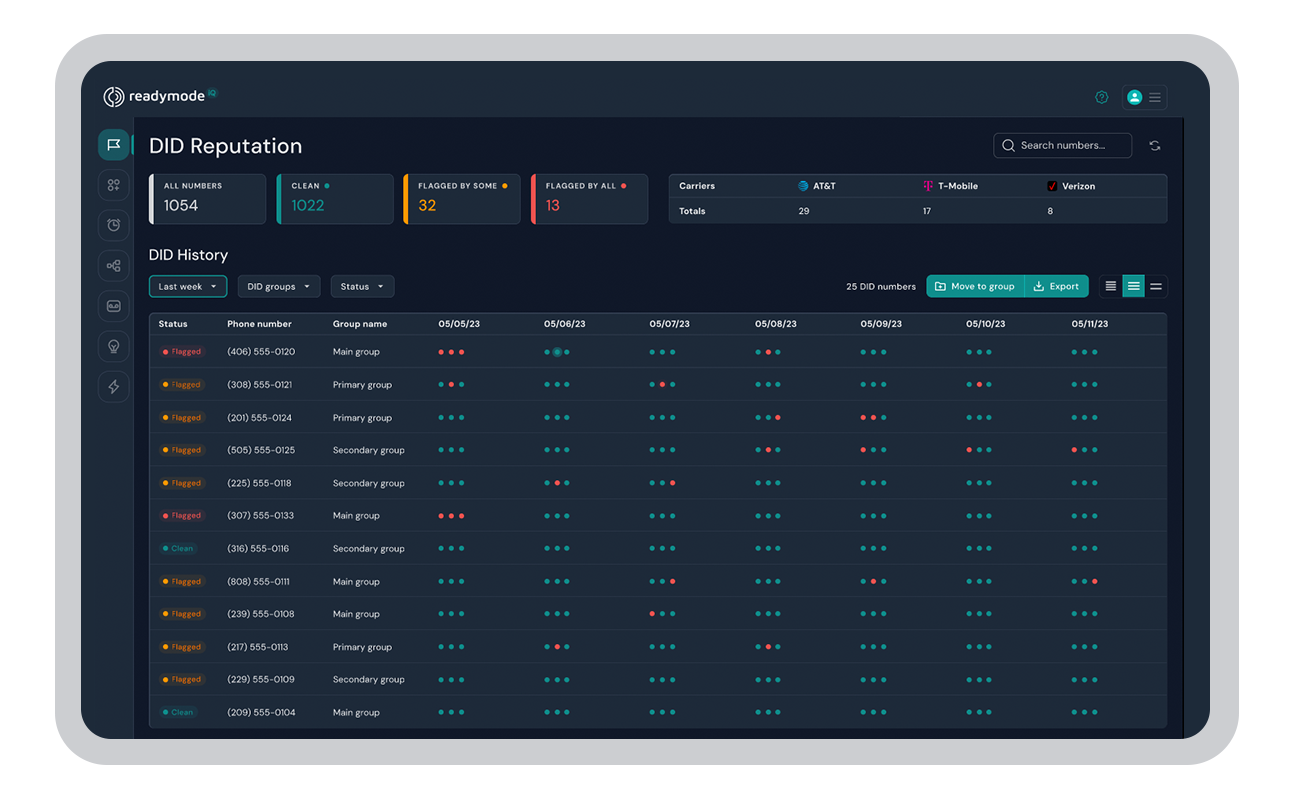
Advanced reputation monitoring tracks how each phone number appears across major wireless networks and calling environments. It shows whether a number is clean, partially flagged, or fully flagged, and updates this information regularly as reputation signals change over time.
Outbound teams need this visibility because caller ID reputation is not consistent everywhere. A phone number can perform well in some situations while being flagged or deprioritized in others. Without reliable, up-to-date insight, teams are often forced to make assumptions, pause numbers too late, or replace numbers unnecessarily.
By clearly showing where reputation issues exist and where they do not, advanced reputation monitoring helps teams make better dialing decisions before answer rates drop. This protects trusted numbers, reduces unnecessary replacements, and supports stronger connect rates over time.
Feature #2: Automatic Number Registration and Managed Remediation
Automatic number registration is the process of registering your phone numbers with major carriers so they’re recognized as legitimate business numbers. This helps prevent negative call labels from appearing in the first place by establishing trust early with carrier networks.
Outbound teams need this because unregistered numbers are more likely to be misidentified or flagged as suspicious, especially at scale. When issues do occur, remediation support helps address active flags by working with carriers to correct false or outdated labels.
Together, registration and remediation reduce reliance on constant number replacement, lower operational costs, and support a healthier caller ID reputation that performs consistently over time.
Feature #3: Carrier-Level Intelligence for Smarter Number Usage
Carrier-level intelligence shows which carrier a prospect uses and matches that data with the real-time reputation of each phone number. This gives outbound teams a clear view of where numbers are trusted and where they may be flagged.
This matters because caller ID reputation isn’t universal. A number can be flagged on one carrier but still perform normally on another. For example, if a number is flagged on AT&T but remains clean on Verizon, carrier-level intelligence only selects that number to call prospects on Verizon, instead of being taken out of rotation entirely or dialed blindly.
By routing calls this way, teams can continue using partially flagged numbers safely, get more value from their existing number pool, protect overall reputation, and improve connect rates without taking unnecessary risks.
Feature #4: Proactive Dialing Safeguards
Proactive dialing safeguards are built-in controls that manage how often and how aggressively each phone number is used. These safeguards include limits on daily call volume per number, controlled pacing, and structured number rotation for new numbers.
Outbound teams need these protections because caller ID reputation is heavily influenced by dialing behavior. Overusing a number, dialing too quickly, or scaling too fast can trigger carrier filtering, even when calls are compliant and relevant.
By automatically enforcing smarter dialing patterns, proactive safeguards help prevent reputation damage before it occurs. This keeps numbers healthy longer, reduces the need for replacements, and supports consistent answer rates as outreach scales.
Feature #5: Built Into a Unified Outbound Calling Platform
A strong caller ID reputation tool should be fully integrated into your outbound calling platform, not bolted on as a separate add-on. This means reputation monitoring, dialing controls, reporting, and workflows all operate within the same system.
Outbound teams need this because caller ID management directly affects how campaigns are built, numbers are assigned, and calls are placed. When tools are disconnected, teams are forced to switch systems, manually update campaigns, or react late to issues.
By embedding caller ID reputation management into a unified platform, teams can manage dialing strategy, monitor performance, and protect their numbers in real time.
This reduces operational friction, lowers costs, and makes caller ID management part of the process instead of an ongoing chore.
Take Control of Your Caller ID Reputation with Readymode iQ
The challenges we’ve discussed so far point to a clear need for a more proactive, intelligent approach to caller ID reputation management.
This is one of the reasons we built Readymode iQ. It is designed for outbound sales, lead generation, and call center teams that rely on phone outreach and need to protect answer rates as they scale.
Instead of just reacting after numbers are flagged, Readymode iQ helps teams prevent reputation issues before they occur, maximize the value of their phone numbers, and maintain consistent connect rates.
Key capabilities of Readymode iQ include:
- Caller ID Reputation Monitoring: Provides clear visibility into how your phone numbers appear across major carriers, showing which carriers have flagged specific numbers so teams can act before performance drops.
- Managed Remediation: Automatically registers phone numbers with major carriers to reduce the likelihood of negative call labels and supports resolution of existing flags, limiting the need for frequent number replacement.
- Custom Call Cadences: Gives teams control over dialing behavior, including pacing rules and retry logic, so outreach stays effective without overusing individual numbers.
- Autopilot Number Selection: Selects the best numbers to dial from based on real-time caller ID reputation signals from major carriers like AT&T, Verizon, and T-Mobile, while distributing call traffic to help prevent reputation damage.
- Autopilot Smart Mode (Carrier-Level Intelligence): Uses carrier-specific insights to avoid calling carriers that have flagged a number, strategically deploy partially flagged numbers where they remain trusted, and adjust call volume to extend number lifespan.
- Built-In Number Protection at Scale: Each Readymode iQ license includes 75 free phone numbers (DIDs), helping teams avoid overdialing and maintain healthier dialing patterns from day one.
Together, these features make caller ID reputation management a built-in part of your outbound strategy rather than an ongoing manual task.
If you want to see how Readymode iQ helps teams improve connect rates and protect their outbound performance, book a demo and explore the platform firsthand.
Frequently Asked Questions About Caller ID Reputation Management
1. How long does it take for a phone number to develop a poor caller ID reputation?
A number’s reputation can decline within days if it’s overused, poorly paced, or repeatedly ignored by recipients.
2. Do local presence numbers automatically improve answer rates?
Local presence can help, but only when paired with healthy dialing behavior and a strong caller ID reputation.
3. Can inbound call activity improve a number’s reputation?
Yes. Carriers view inbound engagement as a healthy signal, and when it happens organically, it can help support outbound calling activity.
4. Can one bad campaign damage an entire number pool?
Yes. Poor pacing or high rejection rates in a single campaign can negatively affect multiple numbers if traffic isn’t distributed properly.
5. Is caller ID reputation management only important for high-volume teams?
No. Even smaller teams can experience major performance losses if their limited number pool becomes flagged.
6. Do carriers share the same reputation data with each other?
No. Each major carrier evaluates numbers differently, which is why reputation can vary by network.
7. Can caller ID reputation be fully “fixed” once it’s damaged?
Some issues can be remediated, but long-term success depends on preventing future damage through better dialing practices and controls.

Jawad Khan
Jawad is a seasoned content marketer and freelance technology writer featured in some of the world's leading digital marketing, e-commerce, and software related publications. As an expert contributor, Jawad has written for startups and enterprises, including Fortune 500 companies, across various tech verticals.