How many live conversations does your dialing system actually deliver to agents each hour?
Don’t focus only on how many calls your team places. A large number of answered calls are picked up by voicemail systems, not by real prospects.
Your agents may be spending a large part of their day listening to recorded greetings, waiting for tones, and manually ending calls without ever speaking to the intended contact.
This, of course, lowers the overall return on your outbound investment.
You can reduce this inefficiency by using an outbound calling system that includes Answering Machine Detection (AMD).
AMD identifies voicemail before the call reaches the agent and filters out machines in real time. As a result, each agent spends more of their shift speaking with live prospects.
In this article, we will explain how AMD works and how it improves the performance and return of outbound calling operations.
TL;DR: Why Outbound Teams Need Answering Machine Detection
Answering Machine Detection (AMD) is a feature in outbound dialing software that identifies whether a call is answered by a live person or a voicemail system. It filters out voicemail before the call reaches your agent, so your team spends more time speaking with real prospects and less time handling unproductive calls.
How AMD works:
- Your dialer places a call using power, progressive, or predictive mode.
- The system analyzes the first few seconds of audio after the call connects.
- If it detects a live greeting, it routes the call to your agent.
- If it detects voicemail, it disconnects or triggers a preset action like voicemail drop.
Key benefits of AMD for outbound teams:
- Increases agent talk time and overall efficiency
- Improves ROI from the same dial volume
- Strengthens reporting accuracy and campaign optimization
- Reduces over-dialing pressure in predictive campaigns
- Improves lead recycling strategy and second-pass ROI
Readymode combines AMD with caller ID reputation monitoring, compliance safeguards, and automation tools to create a structured outbound dialing system that helps your team connect with more live prospects.
What Is Answering Machine Detection & How Does It Work?
Answering Machine Detection (AMD) is a feature in modern outbound dialing software like Readymode that automatically detects whether a call is answered by a live person or by an answering machine.
When the system detects voicemail, it prevents the call from reaching the agent and moves on based on your settings. This process helps your team spend more time speaking with real prospects instead of listening to recorded greetings.
Outbound sales teams in insurance, solar, real estate, home improvement, and other high-volume industries rely on AMD to protect agent time. Without this feature, your agents may only realize a call reached voicemail after listening to the greeting.
By that point, valuable seconds or even minutes are already lost.
AMD becomes especially important when you use progressive or predictive dialing modes.
In progressive dialing, the system automatically places the next call as soon as an agent becomes available.
In predictive dialing, the system places multiple calls at once based on expected agent availability. If your system connects agents to voicemail during these automated workflows, you reduce the efficiency these dialing modes are meant to create.
How Answering Machine Detection (AMD) Works
Let’s explain the AMD workflow with a hypothetical scenario.
- Step 1: Your agent logs into a campaign in Readymode and begins dialing using power, progressive, or predictive mode.
- Step 2: The system places calls automatically. When someone answers, the software listens to the first few seconds of audio.
- Step 3: If the system detects a short human greeting followed by silence, it routes the call to the agent immediately.
- Step 4: If the system detects a longer recorded message with no pause, it classifies the call as voicemail and follows your configured action (such as logging it as voicemail or triggering voicemail drop).
Your agent does not need to wait through the greeting to find out whether the call is with a real person. The system makes that decision before the agent gets involved.
As a result, your team spends more time talking to real prospects and less time on wasted calls.
5 Benefits of Using Dialing Software With Answering Machine Detection
Answering Machine Detection changes how your outbound system performs at a structural level. When you filter voicemail before the call reaches your agents, you directly improve efficiency, reporting accuracy, and overall return on outbound investment.
Here are the practical benefits you can expect.
1. Improve Agent Efficiency
Agent efficiency depends on how much time your team spends speaking with real prospects, not just the number of dialed calls.
Without Answering Machine Detection, your agents must manually identify voicemail after the greeting begins. That process consumes time that could have been spent on a live conversation.
When your dialing system filters voicemail automatically, your agents move from one live conversation to the next without interruption.
This boosts talk time, cuts idle time, and helps your team maintain better momentum throughout the shift.
This improvement becomes more noticeable in high-volume environments such as cold calling agencies and BPOs, where your agents place hundreds of calls per day.
2. Increase ROI from Outbound Calling
You invest in agents, lead lists, dialing infrastructure, and compliance systems when setting up an outbound calling operation. The return on that investment depends on how many productive conversations your system generates.
When AMD increases the percentage of live connections per hour, you improve the output generated from the same number of dials.
More live conversations create more opportunities for qualification and conversion.
Over time, this directly impacts cost per acquisition and revenue per agent, as your system delivers more value from the same activity.
3. Strengthen Reporting and Campaign Optimization
If your campaign reports combine voicemail outcomes with live answers, you cannot accurately measure live answer rates or agent performance.
AMD separates voicemail from live conversations at the system level.
You can see how many calls reach voicemail and measure agent conversion rates based only on real conversations. You can also evaluate list quality by reviewing voicemail ratios across campaigns.
This level of detail helps you make better decisions.
For example, if a list produces a high volume of voicemail, you can adjust your targeting or reconsider the lead source. If your live answer rate declines, you can review your caller ID reputation or adjust the time of day you place calls.
With clearer data, you base your campaign decisions on actual performance instead of assumptions.
Your optimization decisions become data-driven instead of reactive.
4. Reduce Over-Dialing Pressure in Predictive Campaigns
Predictive dialing relies on call pacing algorithms to keep agents continuously engaged. But when your agents frequently connect with voicemail, managers often respond by increasing dial ratios to maintain conversation flow.
But higher dial ratios can create new risks, including abandoned calls, compliance concerns, and unnecessary carrier scrutiny.
Accurate voicemail detection reduces the need to compensate with aggressive pacing.
When your system delivers a cleaner stream of live connections, you can maintain performance without pushing dial ratios beyond sustainable levels.
This protects both your operational stability and your long-term ROI.
5. Improve Lead Recycling Strategy
Your outbound campaigns rarely succeed on the first attempt. Many prospects respond on the second, third, or fourth call. How you manage reattempts directly affects overall campaign performance.
When your dialing system accurately classifies voicemail outcomes, you gain clear data on which contacts have not yet resulted in a live conversation. You can build structured follow-up strategies based on verified voicemail outcomes instead of guessing whether a live person answered.
This approach reduces unnecessary repeat calls to numbers that consistently go to voicemail. At the same time, it allows you to prioritize leads with a higher probability of reaching a live prospect.
Over time, you extract more value from the same lead pool without increasing acquisition spend.
Why Choose Readymode iQ’s Advanced Answering Machine Detection
Answering Machine Detection works best when you embed it inside a broader outbound system that focuses on increasing live conversations and protecting agent time.
If your dialing environment lacks structure, filtering voicemail alone will not solve deeper efficiency problems. You need automation, reputation control, pacing intelligence, and structured follow-up working together.
Readymode iQ approaches Answering Machine Detection as part of that complete system. The platform combines adjustable AMD with caller ID reputation monitoring, intelligent number selection, remediation support, voicemail automation, and structured call cadences.
Let’s break that down.
1. Adjustable Detection Based on Your Campaign
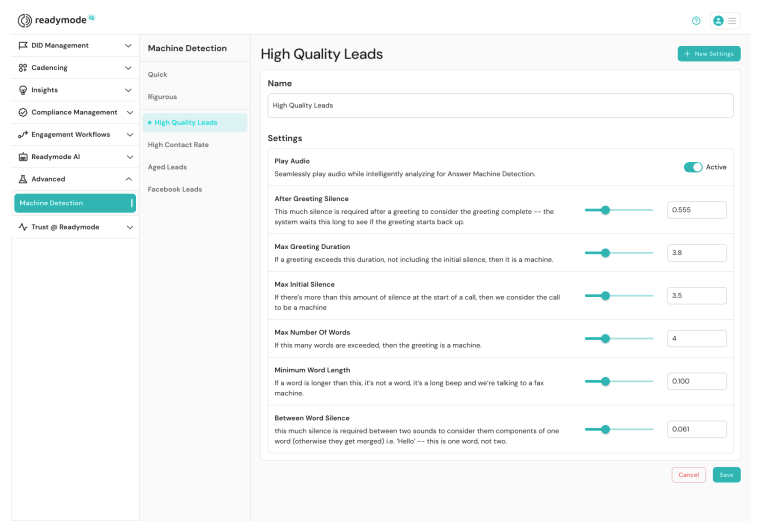
Readymode iQ gives you direct control over AMD sensitivity.
- You can increase sensitivity if voicemail volume consumes too much agent time.
- You can reduce sensitivity if you want to minimize the risk of missing short live greetings.
Your campaign goals, list quality, and dialing mode should determine this setting. When you control detection thresholds, you control how aggressively your system protects agent hours.
AMD or voicemail detection in Readymode iQ works in:
- Power dialing
- Progressive dialing
- Predictive dialing
These are the dialing modes where automated filtering produces the greatest efficiency gains. Preview mode remains agent-controlled and does not use AMD.
If you want a deeper technical walkthrough of these different modes, you can review the detailed breakdown in our dedicated blog post.
2. Caller ID Reputation Monitoring Increases Live Answers
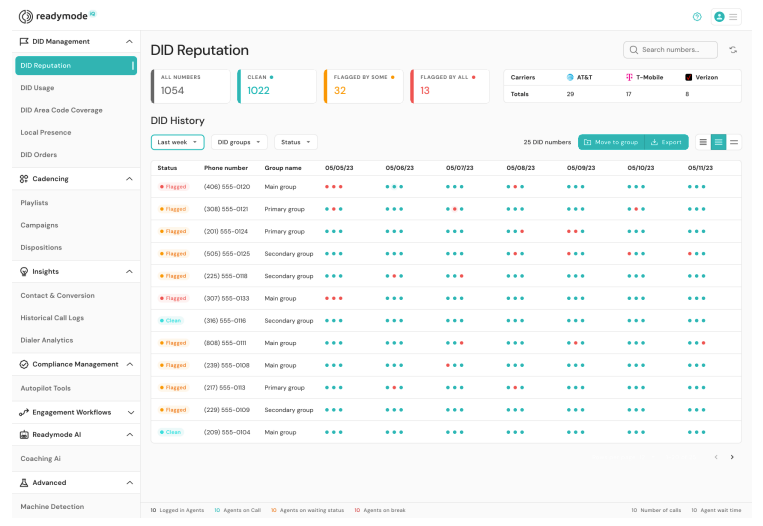
Caller ID reputation monitoring affects how often a live person answers your calls. Answering Machine Detection determines whether that answered call reaches your agent.
Readymode iQ shows you:
- Which numbers carriers have flagged
- How your caller ID appears on recipient devices
- Where negative labeling may reduce answer rates
When carriers flag your numbers, fewer people answer. When fewer people answer, your agents receive fewer live conversations regardless of your AMD settings.
By identifying and resolving labeling issues early, you increase the number of answered calls entering your dialing system. From there, AMD filters voicemail and routes live answers to your agents.
Together, these systems help you increase the number of productive conversations per hour.
3. Autopilot Selects the Best Numbers Automatically
Readymode’s Autopilot feature strengthens dialing performance by selecting the phone numbers most likely to generate live answers.
Autopilot includes carrier-level intelligence that analyzes number performance across carriers. It uses that intelligence to deploy partially flagged numbers strategically instead of overusing them.
Autopilot also helps reduce negative call labels over time by managing number rotation more intelligently.
When your system automatically prioritizes stronger-performing numbers, more calls reach live prospects. As more live answers enter your dialing workflow, AMD can filter voicemail efficiently and route real conversations to your agents.
This coordination increases productive conversations without increasing dial volume.
4. Managed Remediation Protects Long-Term Performance
Managed Remediation registers your numbers with major carriers for you.
This process helps prevent negative call labels and resolve existing ones. Stronger caller ID reputation improves answer rates across campaigns.
Improved answer rates increase the volume of real interactions entering your dialing workflow. That strengthens every downstream metric, including agent utilization and revenue per hour.
5. Call Cadences Turn Clean Data Into Structured Follow-Up
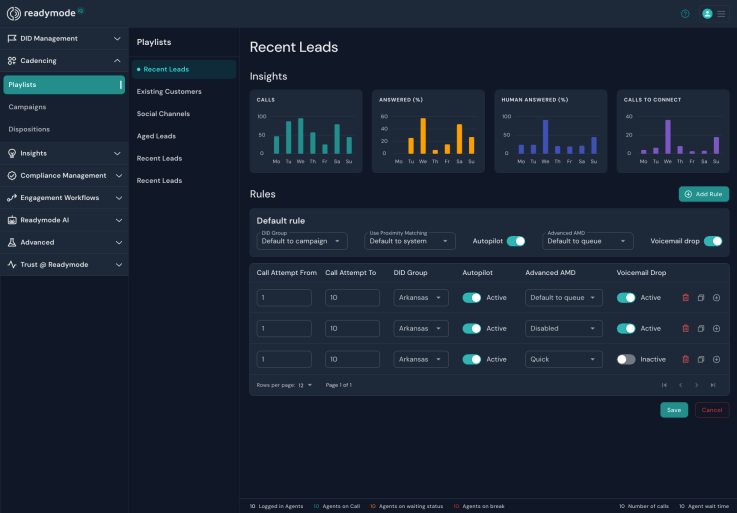
Answering Machine Detection classifies call outcomes clearly. Call cadences allow you to act on those classifications.
In Readymode, you can build custom playlists, campaigns, and dispositions based on verified voicemail outcomes and real conversations. Your team can reattempt leads intelligently instead of guessing which contacts reached a person.
This structured follow-up improves lead lifecycle ROI and lets you extract more value from each list without increasing acquisition spend.
6. Voicemail Drop Maintains Coverage Without Wasting Time
In Readymode, voicemail drop connects directly to your AMD workflow. When the system detects a machine, it can leave a prerecorded message automatically for qualifying users.
Your agents do not wait for the tone or record manual messages. Readymode logs the action and moves forward.
As a result, you maintain message coverage while protecting agent productivity.
Experience Readymode iQ’s Integrated Answering Machine Detection System
Readymode iQ combines multiple outbound efficiency components into one coordinated dialing environment.
Its adjustable Answering Machine Detection filters combined with reputation monitoring, Autopilot, and compliance features give your team a complete productivity ecosystem.
If you want to see how this system performs in your environment, book a free demo of Readymode iQ now and evaluate how advanced AMD fits into your outbound workflow.

Jawad Khan
Jawad is a seasoned content marketer and freelance technology writer featured in some of the world's leading digital marketing, e-commerce, and software related publications. As an expert contributor, Jawad has written for startups and enterprises, including Fortune 500 companies, across various tech verticals.