
We live in a world where AI, automation, and scaled marketing campaigns have become so dominant that customers often feel like businesses see them as numbers in a spreadsheet instead of people with real problems to solve.
That’s why more consumers prefer personalized outreach and sales conversations. Recent research backs this up: 74% of people are more likely to buy when an offer feels personalized to their needs.
But when your agents are making hundreds of calls per day, pulling off personalization manually is quite challenging.
This is where dynamic scripting comes in. It makes personalization simple and achievable, even when you’re calling hundreds of leads a day.
In this article, we’ll explain how dynamic scripting works and why using it can make your outbound campaigns far more convincing.
TL;DR: Why Outbound Teams Should Use Dynamic Call Scripting
Dynamic call scripting software automatically pulls lead details from your CRM into an agent’s script in real time, so every call opens personalized without any manual research.
Here are some ways it benefits your outbound team:
- Personalize conversations at scale — every call opens with real lead details, no matter the volume.
- Standardize outreach across agents — everyone works from the same core script, without losing personalization.
- Train new hires faster — agents don’t need to memorize lead info before dialing.
- Reduce prep time per call — no manual lookup means agents go straight from dial to conversation.
- Support compliance-conscious calling — required disclosures and qualifying questions are built right into the script.
What Is Dynamic Call Scripting Software?
Dynamic call scripting software automatically customizes an agent’s call script based on the prospect’s profile and preferences.
Instead of one fixed script that every agent reads the same way on every call, the script adjusts itself, pulling in details like the prospect’s name, location, or purchase history so the conversation feels more relevant and personalized.
Dynamic scripting pulls this information directly from a CRM or contact database. When an agent opens a lead’s profile, the software matches fields from that record, like name, city, or a custom data point, to placeholders built into the script.
The moment the profile loads, those placeholders fill in with relevant information, so agents never have to manually look up details or memorize them before dialing.
How Dynamic Call Scripts Work in Readymode
Readymode is an all-in-one dialing platform, and dynamic call scripting is one of its core features, built to make personalizing sales conversations easier without adding extra work for your agents.
That data comes straight from your CRM. Every lead profile in Readymode stores standard fields like name, address, and phone number, plus any custom fields your team creates, like lead source, roof age, or policy type.
Dynamic scripts simply pull from whatever’s already sitting in that lead’s record.
The moment an agent opens a lead to make a call, the script is right there alongside the lead’s contact details and call history pulled from your CRM.
Here’s how it works, step by step:
- Scripts are built once, then reused automatically. An admin creates a script under Settings and can restrict it to a specific campaign or team so the right script always shows up for the right calls.
- Variables act as placeholders for real lead data. Using Variables in Readymode, a script can include a field like (First Name) anywhere in the text. That variable is tied directly to the matching CRM field.
- The moment a lead’s profile loads, variables fill in automatically. If a lead’s first name is Olivia, (First Name) becomes “Olivia” the instant the agent opens her profile.
- Variables work both ways. They don’t just display data, they can also collect it. If a script includes a field like (House Age), an agent can type the answer directly into the script while talking to the lead, and it saves straight to that lead’s CRM profile.
- Scripts stay easy to manage. Admins can edit, update, or remove scripts anytime, so scripts can evolve as campaigns change without disrupting agents mid-call.
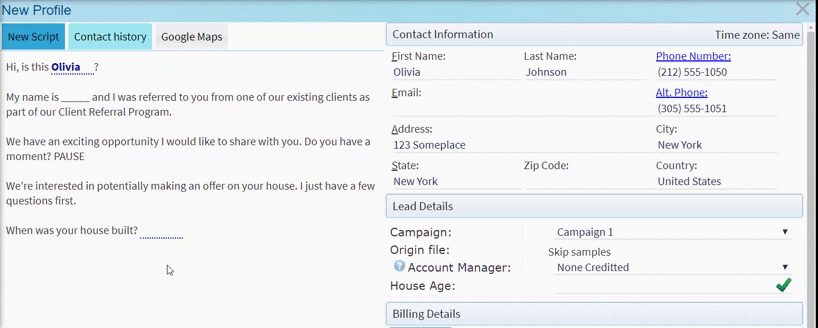
In short, when agents using Readymode open a profile, the finalized script with the right words and the right details is already waiting for them.
5 Benefits of Dynamic Call Scripting Software
Dynamic scripting is most valuable for teams that run high-volume campaigns but still want their conversations to feel personalized. Here’s how dynamic calling software benefits lead generation companies and growing outbound sales teams.
Benefit #1: Personalize Conversations at Scale
Personalizing your conversations and making prospects feel like you understand their problem is the biggest advantage of dynamic scripting.
Research shows that 71% of consumers expect brands to personalize their interactions, and 76% get frustrated when it doesn’t happen.
Dynamic scripts pull lead data automatically, which means agents can open every call with the prospect’s name, location, or other relevant details already in front of them, without any prior research.
This helps your agents break the ice with prospects faster and build a connection point they can use to pitch their offer.
That means a campaign dialing 500 leads a day gets the same personal touch as one dialing 50, because pulling lead details happens automatically.
Benefit #2: Standardize Outreach
Standardizing outreach across your team, so every agent delivers the same core experience to each lead, is another key advantage of dynamic scripting.
This doesn’t work against personalization. The script’s core structure and messaging stay consistent, while the lead details inside it still change from call to call.
Your team pitches with a standard approach, even though every conversation still feels tailored to the person on the line.
Readymode lets you lock scripts to specific campaigns, so agents automatically see the right script for the right lead type.
This keeps messaging consistent across your whole team, even with multiple campaigns running at once. It also makes it easier to measure what’s actually working, since you’re comparing results from the same script instead of a dozen slightly different versions agents wrote on their own.
Benefit #3: Train New Hires Faster
Dynamic scripting helps you train new hires faster, without them needing to memorize lead details before every call.
New agents already have a lot to learn, like your product, your pitch, objection handling, and the dialer itself. Dynamic scripts take one thing off their plate. Since lead details are already embedded in the script, new hires don’t need to cross-reference a CRM or hold information in their head before dialing.
This shortens the learning curve and allows new agents to focus on getting comfortable with the conversation itself instead of juggling where to find each piece of lead information.
Benefit #4: Reduce Prep Time Per Call
Reducing the time agents spend prepping for each call is one of the most immediate ways dynamic scripting boosts productivity.
Without a dynamic script, agents lose seconds, sometimes minutes, pulling up a lead’s profile, scanning for details, and getting oriented before they even say hello. Multiply that across hundreds of calls in a shift, and it adds up to real dead time. Dynamic scripts remove that step entirely. The moment a lead’s profile loads, the script is already populated, so agents go straight from disposition to dial to conversation.
Premier Home Solutions is a great example of how this time saving compounds. After switching to Readymode, Premier Home Solutions grew their productivity by 400%, with dynamic scripting working alongside the predictive dialer and caller ID reputation monitoring to keep agents talking instead of prepping.
Benefit #5: Support Compliance-Conscious Calling
Supporting compliance-conscious calling, especially in regulated industries like insurance, solar, and financial services, is another benefit dynamic scripting delivers at scale.
Scripts can be built to include required disclosures or qualifying questions at the exact point in the conversation they need to happen, so agents don’t have to remember them on their own or risk skipping a step under pressure.
Paired with Readymode’s compliance features, scripts become a built-in safeguard rather than something agents have to keep track of separately.
One Readymode user in telecommunications put it simply in their G2 review: dynamic scripting “changes dynamically according to the various client segments on the fly, ensuring that the appropriate disclosures are always conveyed without the agents having to perform manual checks,” which also made their audit trails “very strong and extremely detailed.”
Best Practices for Using Dynamic Call Scripts
Building a dynamic script is only half the job. How you structure and maintain it determines whether agents actually use it well on live calls to get all the benefits we’ve just discussed.
Here are a few best practices that can make the difference.
- Build scripts around qualification questions: Structure the script so it walks agents through the questions that actually qualify or disqualify a lead. This keeps calls focused and gives agents a clear next step no matter how the conversation goes.
- Avoid overwhelming agents with too much text: A script packed with dense paragraphs slows agents down and makes it harder to sound natural on the call. Keep it scannable, short lines, clear prompts, and only the details agents actually need in the moment.
- Regularly update scripts as campaigns evolve: A script that worked for last quarter’s campaign might not fit a new offer, a new lead type, or a new compliance requirement. Revisit scripts often instead of treating them as a one-time setup.
- Test scripts on a few live calls before full rollout: Before pushing a new or updated script to your entire team, run it on a small batch of calls first. This surfaces awkward phrasing or missing variables early, before it affects your whole campaign.
How Dynamic Scripts Fit Into Readymode’s Outbound Platform
Dynamic scripting is a genuinely useful feature. But it can’t deliver a significant improvement to your outbound operations until it’s part of a bigger system built to support your entire calling process.
Readymode gives you that system.
It combines dynamic scripting with a built-in CRM, predictive dialer, and real-time reporting and analytics into a single interface, so agents don’t need to switch between tools mid-call. The same lead data that fills in a script also feeds your dialer’s call lists and your team’s performance reports.
The result is an integrated system where every piece works together to support your sales team’s performance.
For teams actively scaling, Readymode iQ adds another layer of outbound tools, including caller ID reputation monitoring, Autopilot, and Assisted Remediation. These features work alongside Readymode’s core functionality to protect your answer rates, secure your calling numbers, and identify flagged numbers before they hurt performance.
With all of these tools working together, the personalized conversations your scripts set up actually have a better chance of happening in the first place.
Want to see how it all fits together? Book a demo and see Readymode’s dynamic scripting, CRM, and dialer working as one platform.

Jawad Khan
Jawad is a seasoned content marketer and freelance technology writer featured in some of the world's leading digital marketing, e-commerce, and software related publications. As an expert contributor, Jawad has written for startups and enterprises, including Fortune 500 companies, across various tech verticals.