Outbound calling is changing fast, and 2026 promises to be a pivotal year.
With updates like Apple’s iOS 26 call screening, rapid advances in AI technology, and buyers becoming more selective about which calls they answer, outbound teams are navigating a very different landscape than they were even a year ago.
But here’s the good news. Outbound calling is still one of the most effective ways to generate leads and drive revenue, as long as you adapt to how the industry is evolving.
In this article, we’ll share the latest outbound calling statistics and highlight the trends that are shaping the future of outbound in 2026 and beyond.
TL;DR: The Top Outbound Calling Industry Stats and Trends
The outbound calling industry is shifting rapidly as AI adoption accelerates, consumers demand more relevance and immediacy, and call-screening rules tighten. Revenue teams that modernize will thrive; teams that don’t will see declining connect rates and conversions.
Top Outbound Calling Stats
- 71% of consumers expect personalization, and 76% get frustrated without it.
- 90% of customers say quick response is critical; 60% expect it within 10 minutes.
- 77% of customers expect to reach someone immediately when contacting a company.
- Call volumes have risen for 61% of business leaders since 2020–2021.
- 10% of agent interactions will be handled by conversational AI by 2026.
Top Outbound Calling Trends for 2026
- Personalized outreach is now essential to avoid being filtered out as spam.
- Caller ID reputation management is becoming mission-critical with iOS 26 and carrier crackdowns.
- Speed-to-lead expectations are rising across all industries, requiring faster outreach and smarter routing.
Top 3 Outbound Best Practices
- Optimize sales call timing using industry-specific answer-rate patterns rather than generic windows.
- Use first-party CRM data to continually refresh and validate lead lists for better targeting.
- Build multichannel pre-call touchpoints (SMS, email, voicemail) to increase recognition and pickup rates.
Readymode has all the features and tools to help you evolve with the changing outbound calling industry.
24 Must-Know Outbound Calling Statistics and Trends in 2026
1. Top global brands, including Amazon, Bank of America, Microsoft, and Verizon, outsource large volumes of call center operations.
This validates that outbound calling remains a core channel even for the world’s most advanced companies and shows the scale of opportunity for lead generation agencies and BPOs using the right platform.
2. 71% of consumers expect personalized interactions, and 76% get frustrated when they don’t happen.
Outbound teams who rely on generic outreach risk being instantly dismissed. Personalization now directly affects whether someone is willing to stay on the call.
3. 90% of customers say a quick response is critical, and 60% define “immediate” as within 10 minutes.
If your outbound follow-up isn’t fast and tightly managed, your competitors win the conversation before you even start.
4. 61% of business leaders report call volumes have increased since 2020–2021.
Prospects are harder to reach, and call centers are busier. A strong caller ID reputation and efficient dialing are more important than ever.
5. 71% of Gen Z say live phone calls are the fastest and easiest way to resolve issues.
Younger buyers aren’t avoiding phone calls. They actually trust them. Outbound calling remains highly relevant for sales conversations.
6. 77% of customers expect to reach someone right away when they contact a company.
Teams need strong connect rates and efficient routing. Long wait times or missed calls damage trust instantly.
7. 86% of CRM leaders who use AI say it has helped their operations scale.
From call scripting to designing sales pitches, generative AI tools like ChatGPT, Claude, and Gemini are increasingly taking over routine tasks, allowing outbound teams to focus on higher-value conversations.
8. Companies using AI-enabled agents saw a 14% increase in issue resolutions per hour and a 9% reduction in handling time.
AI improves efficiency beyond outbound workflows. Readymode uses in-product AI chat through Agentforce to support customers inside the platform, separate from customer-facing calling features.
9. The global call center market is projected to reach over $500B by 2030.
Outbound calling is expanding, not shrinking, and competitive pressure is increasing with more teams fighting for buyer attention.
10. 52% of organizations report improved targeting and personalization from first-party data.
Outbound sales success now depends on using your own CRM and interaction data to tailor call scripts and cadences.
11. 80% of consumers say they’d like call/interaction summaries for their records.
This highlights a growing expectation among consumers for clarity and follow-through after sales conversations. Outbound teams that summarize key points, next steps, or commitments after a call build trust, reduce confusion, and create a better overall customer experience, especially in complex or high-consideration purchases.
12. 58% of customers are willing to pay more for a better experience.
High-quality outbound interactions directly translate into revenue and justify premium pricing.
13. A good first call resolution rate benchmark is 70%+.
Outbound teams need strong scripting, training, and CRM access so callers can resolve questions without multiple touchpoints.
14. Average handle time remains ~6 minutes and 10 seconds across industries.
Outbound workflows must support fast, efficient conversations. Long calls reduce throughput and overall conversion rate.
15. Ideal occupancy rate for call centers is 85–90%.
Teams need automation and strong dialer efficiency to keep agents productive without burning them out.
16. Call abandonment rates under 5% are considered best-in-class.
Slow answer speeds or poor routing directly harm outbound conversions and cost real pipeline opportunities.
17. The omnichannel engagement market is projected to reach nearly $18B by 2030.
Outbound calling works best when paired with follow-up channels like text, email, and voicemail drops. Buyers expect coordinated outreach.
18. Automation in agent interactions will increase 6x by 2026, from roughly 1.6% to ~10%.
This reflects a shift away from manual dialing and repetitive call tasks toward dialing software and automated workflows that keep agents talking instead of waiting. Teams still relying on manual dialing will struggle to match the speed, efficiency, and output of teams using modern dialers.
19. 78% of consumers abandon a purchase after a negative experience.
A poor outbound call (wrong timing, poor scripting, unclear identity) directly kills revenue opportunities.
20. Nearly 3 million Americans are employed in call centers.
This remains one of the largest and most active customer engagement channels. Buyers are accustomed to phone-based interactions.
21. Financial services call centers maintain an average CSAT of 79%.
This shows how high the bar is for trust-driven industries. Outbound teams in insurance, lending, and financial advisory must deliver fast, accurate, high-value conversations to meet expectations.
22. Healthcare call centers average a 7% abandonment rate, lower than most industries.
Patients expect fast, reliable communication, which means insurance and health services teams need strong answer speeds and efficient routing to maintain trust.
23. Insurance call centers maintain an average 80% schedule adherence.
Outbound insurance agents, Medicare, life, and property and casualty providers rely heavily on timing and compliance. Staying consistently available is essential for conversions and regulatory requirements.
24. BPO/contact center employees report that 80% consider career growth “critical.”
BPOs power many outbound revenue operations. High agent turnover risk means outsourcing teams must invest in better tooling, coaching, and scripting to maintain consistent performance.
5 Emerging Outbound Calling Trends to Watch Out for in 2026
As these statistics show, outbound teams are operating in a far more complex environment than ever before. Beyond the numbers, several major shifts are reshaping how organizations connect with prospects, build trust, and maintain performance.
Here are the top outbound calling trends that will define 2026 (and what teams need to prepare for now).
Trend 1: Hyper-Personalized Outreach Is Now Essential
Prospects are getting harder to reach, and generic outbound scripts no longer work. With AI making it easy for anyone to generate outreach at scale, buyers are filtering more aggressively and only engaging when a call feels relevant to them.
- Consumer expectations are higher: According to McKinsey, 71% of consumers expect personalized interactions, and 76% get frustrated when those expectations aren’t met. This means personalization directly affects whether prospects stay on the call or assume it’s spam.
- Outbound teams need deeper context: To break through the noise, outbound teams need deeper context on every lead and the ability to tailor messaging in real time.
How Readymode helps teams personalize at scale
Readymode supports deeper personalization by giving agents the information and tools they need at the moment of the call.
- Built-in CRM: The platform’s built-in CRM surfaces lead history and key details instantly
- Dynamic scripting: Adjusts talking points based on lead data
- Live call monitoring: Helps managers coach agents toward more relevant conversations
- AI coaching integrations (e.g., Balto AI): Outbound teams can refine messaging on the fly and deliver outreach that feels informed, human, and trustworthy.
Trend 2: Remote and Hybrid Work Are Reshaping Outbound Operations
Outbound teams are no longer centralized. Remote and hybrid work models have become the norm across sales, insurance, financial services, real estate, and BPO operations. This shift creates new operational challenges that on-premise phone systems are not built to support.
- More distributed teams: Remote agents require stable access to dialing tools, call controls, and CRM data, but traditional on-site hardware introduces bottlenecks like restricted access, inconsistent performance, and downtime.
- Rising operational complexity: Teams need a way to monitor performance, maintain compliance, and coach agents in real time, even when no one is physically in the same location.
Modern outbound operations must run on cloud-based, virtual platforms that deliver consistent call quality, centralized visibility, and remote-friendly workflows.
How Readymode supports remote and hybrid outbound teams
- Cloud-based platform: Agents can log in and work from anywhere without requiring local hardware.
- Centralized monitoring: Managers can monitor calls, whisper, barge, and review performance regardless of where their team is located.
- Unified workflow management: Scripts, campaigns, and compliance settings can be updated instantly and applied across the entire remote team.
- Reduced infrastructure cost: No physical PBX, SIP hardware, or on-site maintenance, making scaling remote teams significantly more efficient.
Trend 3: Caller ID Reputation Is Becoming Mission-Critical
Carriers are tightening spam-filtering systems, and Apple’s new iOS 26 call screening adds another layer of detection. As a result, outbound teams face more barriers than ever when trying to reach prospects by phone.
- Stricter carrier and device filtering: Even legitimate calls can be flagged or blocked if the number is not properly registered, has too many short calls, or shows any activity associated with spam behavior.
- More cautious consumers: Most prospects will not answer unidentified or suspicious numbers. Caller ID transparency has become directly tied to trust and connect rates.
Outbound teams now require continuous reputation monitoring, verified number registration, and strategic dialing patterns to keep numbers healthy and ensure calls reach live prospects.
How Readymode protects caller ID reputation
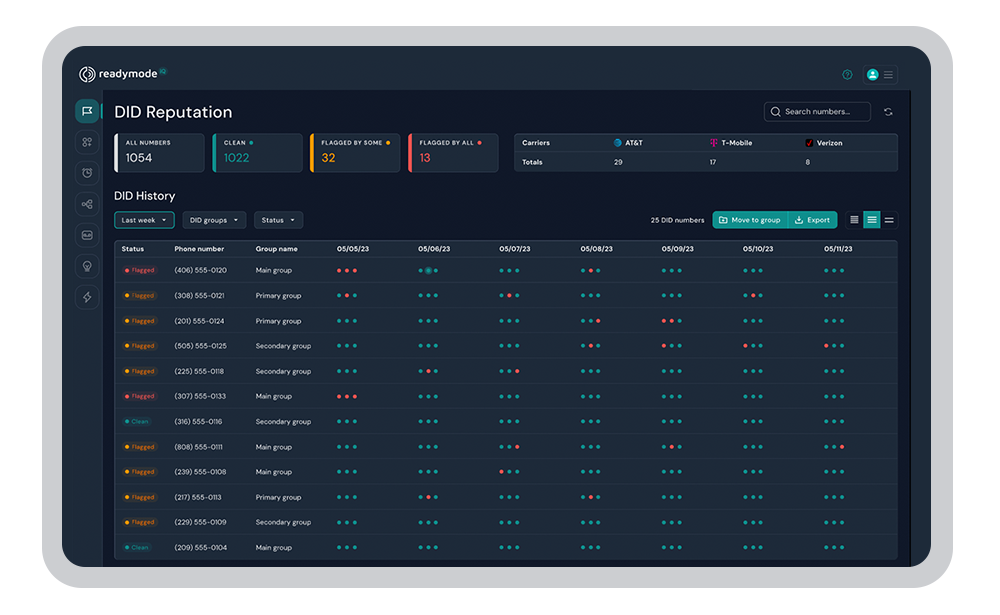
- Managed Remediation: Readymode iQ offers Managed Remediation, which ensures every outbound number is properly registered to your business, reducing the chance of being mislabeled.
- Caller ID reputation monitoring: Identifies early spam flags so teams can take corrective action before performance drops.
- Autopilot: Automatically manages numbers to prevent long-term damage and maintain strong connect rates, while prioritizing outbound calls from numbers that have recently shown higher performance.
- iOS 26 and carrier compliance alignment: Readymode supports carrier authentication and iOS 26 call screening readiness, offering preview and power dialing options that ensure live agents are available when prospects answer, helping teams maintain trust and avoid negative call delivery signals.
These tools work together to protect trust, improve answer rates, and reduce the impact of increasingly aggressive carrier and device-level screening.
Trend 4: Agent Training and AI-Assisted Coaching Are Becoming Critical
Outbound calling is becoming more complex as AI tools evolve, compliance requirements tighten, and customer expectations rise. As a result, agent performance depends on more than just following a script. Teams need stronger skills, better coaching, and real-time support to meet these higher standards.
- Skills now drive performance: Research from the Content Marketing Institute shows that team skills and capabilities are among the strongest drivers of business results, surpassing technology and budget increases.
- Training directly impacts retention: McKinsey reports that empowered and well-trained agents are 8.5x more likely to stay and deliver stronger outcomes. In an industry where turnover is expensive, this makes training a core performance strategy.
Outbound teams need structured training, consistent coaching, and tools that provide real-time support during calls so agents can stay compliant, handle objections, and deliver better conversations.
How Readymode strengthens agent performance
- Dynamic scripting: Guides agents with context-aware scripts that adapt to the lead’s data.
- Live call monitoring: Allows managers to coach in real time and quickly correct gaps in messaging or compliance.
- AI coaching integrations (e.g., Balto AI): Offers real-time feedback, objection handling cues, and compliance reinforcement during the call.
- Faster onboarding support: Combined, these tools reduce ramp time and create a more consistent level of agent performance across the entire team.
With stronger training and AI-assisted guidance, outbound teams can deliver more effective conversations and build long-term agent confidence and retention.
Trend 5: Speed-to-Lead Expectations Are Increasing Across Every Buying Segment
Customer expectations for fast responses are rising across all industries. People expect businesses to respond almost instantly, and outbound teams are now being judged by the same standards as inbound support.
- Customers expect immediacy: Ninety percent of customers say a quick response is critical, and sixty percent define “immediate” as within ten minutes.
- Instant access expectations: Seventy-seven percent expect to reach someone right away when contacting a company. These expectations influence whether a prospect stays engaged or moves on to another provider.
Prospects will not wait for slow follow-up. If agents cannot return calls or respond to new leads within minutes, competitors will reach them first. Rising call volumes make fast outreach even harder, which increases the need for automation, stronger routing, and tools that reduce manual delays.
How Readymode helps teams improve speed to lead
- Predictive dialer: Readymode’s predictive dialer removes manual dialing delays and maximizes talk time so agents reach more leads quickly.
- Real-time lead delivery: Routes new leads to available agents the moment they enter the system to accelerate first contact.
- Automated call routing: Ensures calls are directed to the right agent without wasted time or misrouted attempts.
Together, these capabilities help outbound teams respond faster, stay competitive, and start more conversations before other providers have a chance.
5 Outbound Calling Best Practices to Apply Today
To stay ahead, outbound calling teams must apply practical, data-driven best practices that directly improve connect rates, compliance, and overall call performance.
Here are five high-impact best practices you should implement immediately.
Best Practice 1: Optimize Call Timing Windows Based on Industry Behavior
Different industries answer calls at different times, and high abandonment benchmarks in sectors like health insurance and financial services show how sensitive buyers are to timing.
Outbound teams should analyze their own answer-rate data to identify peak windows and adjust dialing rules instead of relying on generic calling hours.
Even a small shift in timing can dramatically increase connect rates.
Best Practice 2: Use First-Party Data to Refresh and Validate Lead Lists Regularly
As more marketers prioritize first-party data in response to tightening privacy regulations, outbound teams should routinely refresh and validate lead lists using CRM insights, past call behavior, and engagement history.
This helps prevent agents from wasting time on stale or low-intent contacts and improves personalization since messaging aligns with recent interactions.
Best Practice 3: Build Multichannel Pre-Call Recognition Touchpoints
The omnichannel engagement market is expected to reach USD $18 billion by 2030. Outbound teams should prime prospects before a call by sending a brief SMS, email, or voicemail drop. These “recognition signals” increase the chance that prospects will pick up because they already know who is calling and why.
This is especially effective in industries where trust matters, like health insurance, finance, home improvement, or B2B.
Best Practice 4: Track and Improve First Call Resolution Rates, Not Just Connect Rates
A strong FCR benchmark of 70% or higher shows that the first conversation is often the only opportunity to build trust.
Outbound teams should measure FCR as a core KPI and train agents to resolve objections, answer coverage questions, and provide next steps immediately. This reduces repeat dialing, increases conversion efficiency, and improves overall customer experience.
Best Practice 5: Create a Dedicated Caller ID and Compliance Maintenance Routine
Because spam filtering is increasing and abandonment thresholds are tightening, outbound teams should implement a routine to review DID performance, register numbers, rotate low-performing DIDs, and document compliance practices.
Treat this as a weekly operational task rather than a reactive fix. With tools like Readymode iQ, much of this work is automated through caller ID reputation monitoring, Managed Remediation, and Autopilot, which continuously identify risk, remediate flagged numbers, and optimize number usage without manual intervention.
Maintaining a clean caller ID reputation protects conversion rates over the long term and reduces the risk of carrier-related delivery issues.
Is Your Outbound Calling Strategy Evolving With the Industry?
The outbound calling industry is evolving faster than ever, driven by new technology, shifting buyer expectations, and stricter call-screening rules. Teams that continue operating the same way they did even a year ago will struggle to stay competitive.
Readymode helps outbound sales and lead generation organizations navigate this transition with ease.
Our continuously improving feature set, from advanced caller ID protection to dynamic scripting, and industry-leading dialing efficiency, gives you the tools you need to adapt, stay compliant, and outperform competitors.
If you want to future-proof your outbound operations and turn these industry shifts into an advantage, now is the time to modernize.
Book your free Readymode demo today and experience the platform firsthand.

Jawad Khan
Jawad is a seasoned content marketer and freelance technology writer featured in some of the world's leading digital marketing, e-commerce, and software related publications. As an expert contributor, Jawad has written for startups and enterprises, including Fortune 500 companies, across various tech verticals.