
Your dialer’s pricing model plays a critical role in determining your campaign’s profitability and ROI.
Whether you’re running small outbound campaigns or a full-scale sales operation, modern dialer platforms mostly offer flat-rate and per-minute pricing models.
Both have their pros and cons depending on your business circumstances and goals.
But a dialer that looks cheap upfront doesn’t necessarily stay cheap once you scale. Costs can add up quickly, and by the time you notice, switching platforms or changing your pricing model becomes an even bigger expense.
So, choosing a pricing model that aligns with your business is a serious decision with long-term implications.
In this article, we’ll explain flat-rate and per-minute pricing for outbound dialing platforms and help you determine the right choice for your business.
TL;DR: Flat or Per-Minute Pricing in Dialing Software – Which Is the Right Choice?
Most outbound dialing software bills your outbound minutes one of two ways, flat-rate or per-minute. Which one offers a better ROI depends largely on your business goals.
What is flat-rate pricing? Pricing that charges one fixed monthly cost, no matter how many minutes your team logs.
What is per-minute pricing? Pricing that charges a set rate for every minute of outbound talk time your team actually uses.
Per-minute pricing is right for: Small or sporadic call volume, seasonal campaigns, or testing a new list or market before scaling.
Flat-rate pricing is right for: Steady or growing call volume, predictive dialing, or when you want a predictable monthly cost as your team scales.
Understanding the Two Main Pricing Models In Outbound Dialers
Most outbound dialing solutions consider your agents’ talk time when determining their subscription price. Dialer software either bundles that talk time into your subscription at one fixed rate, or bills you for it as you go.
Let’s take a closer look at how each pricing model actually works.
Pricing Model #1: What Is Flat-Rate Pricing?
Flat-rate pricing means your outbound talk time is included in your license cost at one fixed rate every month. Some companies call it unlimited pricing or all-inclusive pricing, since your minutes are bundled into what you already pay per license instead of billed separately.
So your invoice looks the same whether your team logs 5,000 minutes of talk time or 15,000 minutes in a given month.
The upside of this pricing model is predictability. You know what you’re paying before the month even starts, and a strong campaign won’t turn into a surprise bill.
But if you have limited operations and your team dials a small, steady list each month, you may end up paying for capacity you don’t fully use.
Pricing Model #2: What Is Per-Minute Pricing?
Per-minute pricing means you pay for outbound talk time based on how many minutes your team actually uses, billed at a set rate per minute. Some companies call it metered pricing or pay-as-you-go pricing, since your invoice moves up or down depending on usage. So a slow month costs less, and a busy month costs more.
This model is more flexible and sounds cheaper at first.
If your call volume is low or inconsistent, you’re only paying for the minutes your team actually logs, not for capacity sitting unused. However, that same flexibility can work against you.
Your talk time and monthly costs can rise fast if you have a bigger lead list or use predictive dialing on a cold list with a lower conversion rate.
On a large-scale campaign, per-minute pricing can become a significant expense and drag your ROI down.
Flat-Rate vs Per-Minute Pricing Comparison
Here’s a more specific comparison of the two pricing models to help you understand how they work.
| Aspect | Flat-Rate Pricing | Per-Minute Pricing |
| How you’re billed | One fixed rate per license, every month | A set rate per minute of connected talk time |
| Predictability | Same invoice regardless of volume | Invoice shifts with how much your team dials |
| Best fit for | Steady or growing call volume | Low, seasonal, or still-unproven call volume |
| Biggest risk | Paying for capacity you don’t use | Costs climbing faster than expected during a busy push |
| Effect of predictive dialing | No cost impact, more connected calls is pure upside | Directly increases your bill, since more talk time means more cost |
| Ideal list to run it on | Works fine either way, since cost stays fixed | Best on warm or already-qualified lists where conversion is proven |
Why the Lowest Upfront Price Doesn’t Always Mean the Lowest Cost
A per-minute quote can look like the smarter pick when you have a small team and limited operations. It may also be a smart choice if you’re looking to evaluate a specific platform or explore a new market before fully scaling.
But when your operations grow and campaigns get bigger, per-minute costs can quickly add up.
Say your team dials 15,000 minutes a month at $0.03 per minute, a $450 bill. Add a predictive dialer to scale outreach, and that volume can double or triple within a few months. At 45,000 minutes, you’re paying $1,350.
This is usually on top of your license fee which makes it even more expensive.
With a flat-rate plan, that price would have stayed exactly where it started.
So the pricing model that looked cheaper going in can end up costing more once your team actually ramps up.
Here’s specifically when each of these pricing models makes sense.
When Flat-Rate Pricing Makes Sense
Flat-rate pricing makes the most sense for scaling sales operations. When you have a medium-sized team that’s growing fast, or an already-established operation with steady volume, flat-rate pricing tends to deliver a stronger ROI.
You’re going to fully use the minutes you’re paying for, and in most cases go well beyond that, so every extra minute your team dials past that point is essentially free.
It also allows your agents to conduct calls more confidently without a clock ticking in their minds.
So the bigger and busier your operation gets, the more flat-rate pricing pays for itself.
When Per-Minute Pricing Makes Sense
Per-minute pricing makes more sense for smaller teams with limited campaigns and when your call volume is tied to a specific season or cycle instead of year-round operations.
For example, tax prep services in the spring, or retailers ramping up before the holidays see call volume spike for a few months and drop off the rest of the year.
Paying per minute means you’re not carrying the same flat-rate cost through slower months. With that said, you may still need to pay license fees in the meantime.
So the more your call volume is seasonal, cyclical, or tied to a specific client or campaign rather than your core operation, the more per-minute pricing could make sense.
Other Costs Buyers Often Forget to Consider
Choosing between flat-rate and per-minute pricing is only one of the things you need to consider when calculating the cost of a dialing solution.
Most dialers, irrespective of their pricing model, also charge additional costs or don’t include everything in their main pricing. If you forget to include them in your final pricing calculation, the first invoice will come as an unpleasant surprise.
Here are the most common additional costs to consider.
- Carrier fees: Some software solutions charge separately for the carrier costs behind every call, on top of your base rate.
- Account management fees: Dedicated support or onboarding help isn’t always included, and some providers charge extra for it past a basic setup.
- Add-ons for core features: Predictive dialing, caller ID reputation management, and similar features are sometimes priced as extras instead of being included in your base plan.
So, when you’re evaluating a dialer’s total cost, carefully check what’s included in the subscription and what’s charged on top of the regular fee.
Per-minute dialers tend to adopt this approach more often, charging for things on top of the main package since it makes the pricing look more flexible upfront. Most flat-rate platforms bundle everything together, but there can be exceptions, so it’s always worth taking a close look before deciding.
Questions to Ask Before Choosing a Pricing Model
Before you commit to either pricing model, run through these questions with your team. Each one points to a different piece of your total cost picture.
- How much talk time does each agent average? This helps you set your baseline volume and shows which pricing model actually reflects how your team works.
- Will your call volume grow over the next year? Growing volume favors flat-rate pricing, since your cost stays fixed no matter how much you scale.
- Do you run predictive dialing campaigns? Predictive dialing drives up talk time fast, which matters a lot more under a per-minute plan than a flat-rate one.
- Is having a predictable budget important? If surprises in your monthly bill create real problems, flat-rate pricing removes that risk entirely.
- Could minute costs make you hesitate to call enough leads? Cost anxiety under per-minute pricing can shrink your outreach without you noticing, even when more calls would pay off.
- Are you comparing total platform value or just the subscription price? A lower rate isn’t a deal if it excludes features a flat-rate platform already includes.
Why Many Outbound Teams Choose Readymode
Readymode is an all-in-one dialer platform that offers a complete solution for teams scaling their outbound operations at flat monthly rates.
It comes with two different subscription plans that offer enough flexibility without taking away the ability to scale.
Here’s what makes Readymode a top choice for outbound sales and lead generation teams across real estate, insurance, BPOs, home services, and many other verticals.
Free Unmetered Outbound Minutes
Readymode offers free outbound minutes with every plan, subject to our fair use policy. Your bill doesn’t move with your call volume the way a per-minute plan would, which is the exact tradeoff we’ve explained in this guide.
Starter vs. iQ, Flexible Yet Scalable
Readymode offers two distinct subscription plans designed for different business stages.
Readymode Starter is built for small to mid sized (but growing) teams priced at $239 per license per month and covers the core dialing features.
Readymode iQ, at $299 per license per month, adds advanced tools built for higher-volume outreach as your operation grows.
Tools To Help You Maintain Performance While Scaling
Readymode iQ includes multiple tools and features designed to help you maintain performance as your outbound operations grow.
For example, Caller ID Reputation Monitoring helps you track the health of your calling numbers, so that you can identify numbers flagged by a carrier.
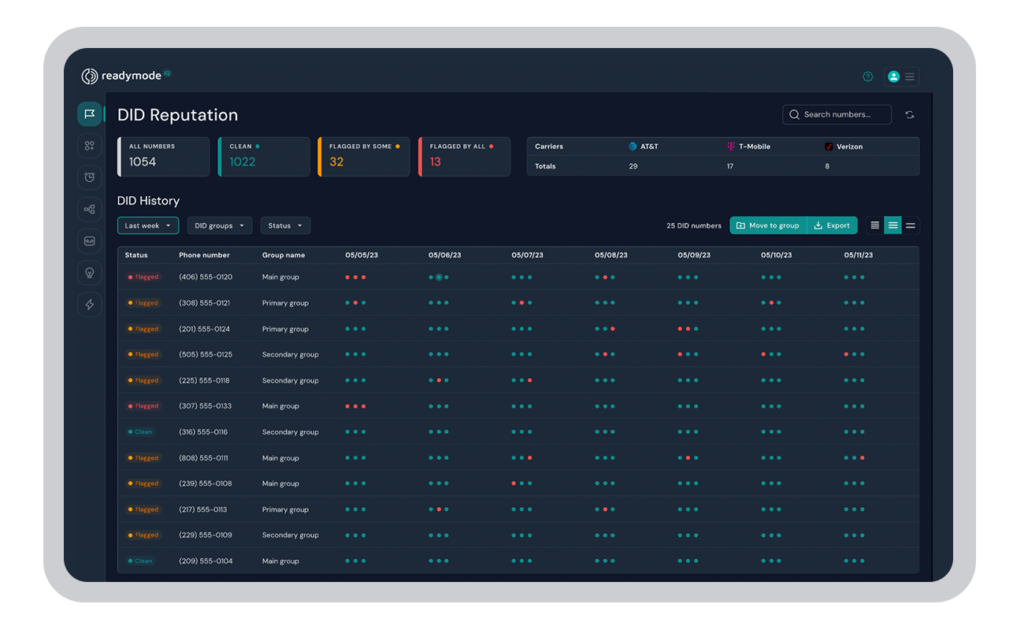
Assisted Remediation registers your numbers with major carriers to help build trust. That trust helps prevent and resolve negative call labels, which improves your phone number reputation.
And the Autopilot feature lets you automatically select the healthiest available number to dial from for each lead based on that lead’s carrier data.
In addition, Custom Call Cadences allow you to build multi-step contact strategies to follow up with your prospects at the right times.
So you get a holistic toolset to run a well-managed outbound operation.
Readymode Lets You Scale Without Worrying About Costs
Since outbound minutes aren’t metered in Readymode, your team can dial as much as the work actually requires instead of watching a bill climb in real time.
This is precisely what happened with our client, Premier Home Solutions.
After moving to Readymode iQ, the company saw a 4x increase in agent productivity and scaled their operations massively while staying compliant. Such results are easier to reach when cost isn’t a factor in how often your reps pick up the phone and you have tools that guard your reputation.
This doesn’t automatically make flat-rate pricing right for every team.
But if your outbound volume is steady or growing, it’s worth seeing the numbers for yourself.
Book a free demo with Readymode and we’ll walk through the details.

Jawad Khan
Jawad is a seasoned content marketer and freelance technology writer featured in some of the world's leading digital marketing, e-commerce, and software related publications. As an expert contributor, Jawad has written for startups and enterprises, including Fortune 500 companies, across various tech verticals.